The short version: the rule changed, not your phone overnight
On July 16, 2026, the European Commission adopted two DMA specification measures for Google: one covering AI-service interoperability on Android, and another covering Google Search data sharing.
For Android users, the important point is not that Gemini is being replaced. It is that competing AI assistants should have a path to Android capabilities that have made Google’s own services more powerful. The Commission’s scope includes invocation through system entry points, consented context, actions across apps, and selected hardware and software resources.
That does not mean any AI can control your phone today. The decision is adopted, but the user-facing result still depends on Android releases, manufacturers, provider eligibility and user consent. This is a policy explainer and checklist, not legal advice and not a verdict on any particular assistant.
What did the EU actually require?
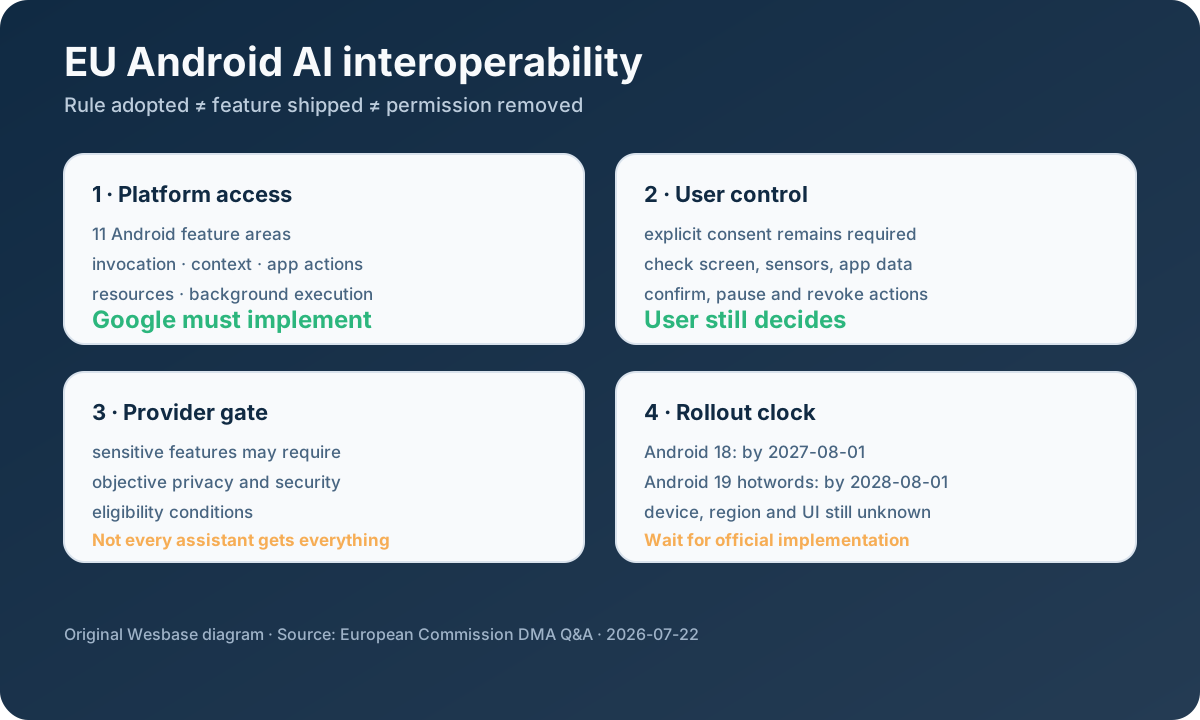
The Commission’s Q&A describes 11 Android feature areas relevant to AI services. For users, they are easier to understand in four groups:
| Capability group | What users may eventually see | What you cannot infer yet |
|---|---|---|
| Invocation | Launching a preferred AI service from a home/navigation entry point or wake word | Every phone will expose the same entry point immediately |
| Context | Using app, screen or sensor context after consent | Any service can read everything by default |
| App and system actions | Completing tasks in apps or changing selected system settings | Every app is already open, or tasks need no confirmation |
| Resources | Using eligible device resources, on-device models or background execution | Model quality, speed or language coverage will automatically match Gemini |
The Commission’s examples include voice activation, drafting or sending an email through a preferred email app, adding items to a shopping list, live translation and proactive suggestions based on context. These are examples in the decision, not proof that a specific phone has shipped each experience.
How could this change user choice?
It may become about more than installing an app
A third-party assistant can be installed on Android today without having the same system reach as a built-in service. If invocation, cross-app actions, screen understanding and background execution are reserved for one platform service, “installed” and “actually useful across the phone” remain very different things. Our Android Gemini Intelligence phone-agent checklist covers Google’s own feature path; this article asks whether competing assistants can gain comparable system access.
The new measures target that gap. Competing services should get access to specified Android capabilities without unnecessary extra friction or a simple requirement that they first become the default role. Google must also provide documentation, testing and technical assistance.
Permissions do not disappear
The more an assistant can do, the more context it may need. The Commission’s Q&A says users must be able to give explicit consent for covered features to the AI assistants they install. That means users should not stop at “this is more convenient”; they should inspect access to the screen, microphone, camera, location, app data and background execution.
For sensitive capabilities, Google may apply objective and non-discriminatory privacy, security and system-integrity eligibility conditions. The Commission lists screen automation, structured app integration, system integration, centralised access to on-device app data and context-aware intelligence among the sensitive areas. “Open access” therefore does not mean every assistant automatically receives every capability.
The timeline matters more than the marketing
The Commission’s Q&A says the main interoperability measures must be implemented in the next major Android release, Android 18, no later than August 1, 2027. Concurrent hotword access for multiple AI services is due in Android 19, no later than August 1, 2028.
These are outer implementation deadlines, not launch dates for a particular phone or assistant. Device model, Android version, region, provider eligibility and manufacturer UI may still determine when a user sees a real feature.
A five-point checklist for later
When the updates arrive, compare an assistant using these checks rather than labels such as “agentic” or “system intelligence.” If it also affects an upgrade decision, use our AI-phone buying checklist to check region, subscriptions, hardware and ownership costs.
- Device and region: Is your phone in the relevant EU rollout and running the Android release that contains the implementation?
- Invocation: Can the assistant use a system entry point or wake word? Does it have to become the default assistant?
- Data and sensors: Which app data, screen, microphone, camera, location or on-device models does it request, and where is consent shown?
- Task confirmation: Before a cross-app action, can you see the target and final action? Can you pause or cancel it?
- Revocation and exit: Can you turn off access, change assistants or stop background execution without breaking unrelated phone functions?
This is not an official five-step EU checklist. It is a reader-facing translation of the decision’s invocation, context, actions, resources, consent and eligibility boundaries.
Do not confuse Search data sharing with phone permissions
The EU also adopted a separate specification for Google Search data sharing. It covers anonymised ranking, query, click and view data for eligible online search engines, including AI chatbots that provide search functionality. That connects to our explainer on Google Search agents becoming task entry points, but it is not the same as Android phone permissions.
That is mainly a provider-side measure. It is not a new Android permission switch and does not give a third-party assistant access to the contents of your phone. The simple distinction is: Android interoperability concerns device capabilities; Search data sharing concerns how search providers can obtain data to improve search services.
What remains unknown?
As of July 22, 2026, the Google system-services release notes I checked do not provide the user-facing UI, first compatible devices or first eligible third-party assistants for these DMA Android measures. The Commission also says the decision specifies what Google must implement, not one fixed technical implementation.
Keep these points open until official documentation arrives:
- Which phone models receive the feature first;
- Which AI services pass sensitive-feature eligibility conditions;
- Whether manufacturers expose identical settings;
- What confirmation, revocation and background-execution prompts look like.
What should you watch next?
The useful next sources are Google’s Android 18/19 implementation and testing documentation, manufacturer update notes for EU devices, and public permission and eligibility details from third-party AI services.
The most meaningful change is not that AI will suddenly do everything for you. It is that system entry points, cross-app actions and permission controls may no longer be exclusive to one platform service. When the features actually arrive, use the five checks above to see whether you gained choice without losing control.
FAQ
Does this replace Gemini as Android’s default assistant?
No. The decision requires effective interoperability for competing AI services, but it does not choose an assistant for users or guarantee identical product experiences.
Can EU users let any AI control their phone now?
No. The decision was adopted on July 16, 2026, but implementation, device coverage, provider eligibility and user interfaces still need to be documented and shipped.
Does interoperability remove microphone, screen or app permissions?
No. The Commission’s Q&A preserves explicit user consent for covered features, and GDPR and other security rules continue to apply.
Is Search data sharing the same as Android AI interoperability?
No. Search data sharing is a provider-side measure for eligible search services and AI chatbots with search functionality, not a new phone permission switch.