Bottom line
Samsung’s July 22 Galaxy Unpacked event is confirmed. That does not mean you should preorder the next AI foldable today.
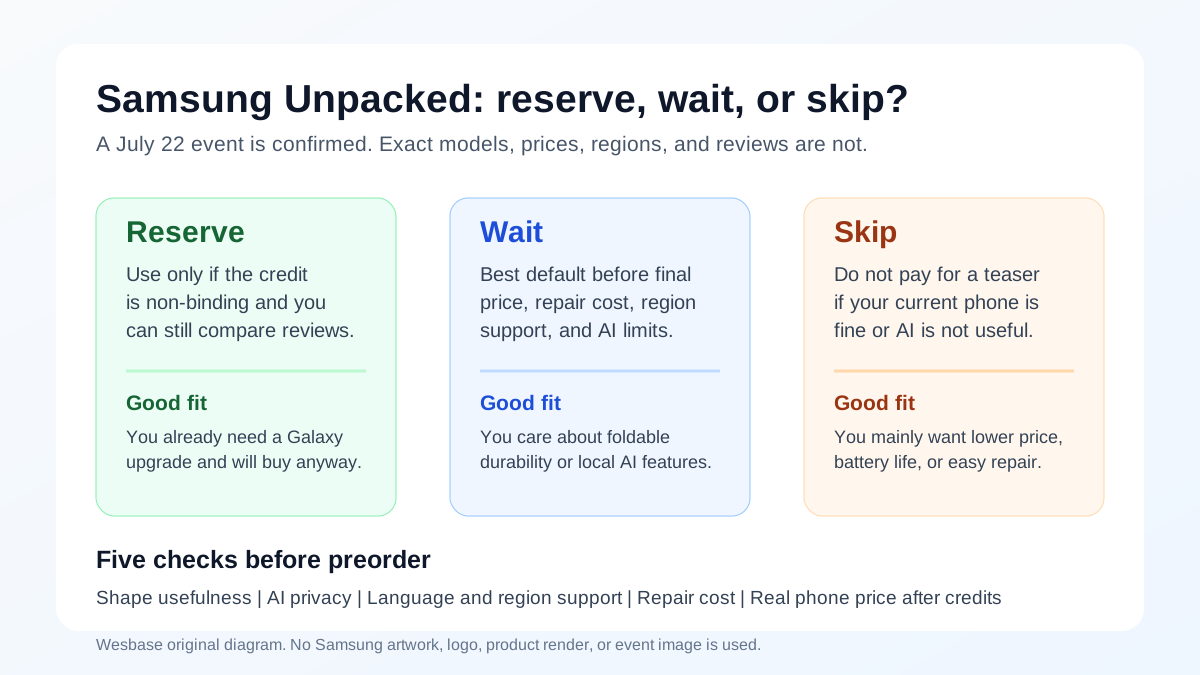
The safer move is this: reserve only if the reservation is non-binding in your region, then wait for final pricing, regional AI availability, repair costs, and independent reviews before buying. For a structured check of region, language, on-device or cloud execution, and subscription terms, use this 2026 AI phone buying guide.
The real question is not only whether Samsung announces a new Fold, Flip, or wider foldable. It is whether Samsung can show that mobile AI is useful enough, private enough, and durable enough to justify a more expensive phone.
What is confirmed
Samsung says Galaxy Unpacked will take place in London on July 22, 2026, and stream on Samsung.com, Samsung Newsroom, and YouTube. The official theme is “A New Shape Unfolds.” Samsung says the next Galaxy portfolio additions will combine intelligent capabilities with innovative form factors and deliver more personal, adaptive experiences.
Samsung’s U.S. Newsroom says reservation customers can receive a $30 Samsung Credit during preorder, with broader savings and sweepstakes language attached. Samsung’s Canadian Unpacked page says the official release date for the new Galaxy models will be announced during the event.
TM Roh’s official editorial supplies the AI frame. He argues that AI is entering an agentic age, where it can take action on a user’s behalf while the person keeps the final decision. The same editorial emphasizes personal context, privacy, and device-level security.
Those are the facts you can cite today: event date, livestream timing, theme, reservation credit, and Samsung’s AI direction. Final model names, prices, launch markets, and feature lists are not confirmed yet.
What is still speculation
The current media focus is a wider foldable. The Verge reads Samsung’s teaser as pointing to a new, broader foldable form factor, alongside likely updates to Flip and Fold devices. Android Central and others are also framing the event around foldables, Galaxy AI, and possible new wearables.
That is useful context, not a buying decision. At least four things remain open:
| Item | Current status | How to treat it |
|---|---|---|
| Final model names | Not confirmed by the invitation | Wait for the keynote |
| Price | Not announced | Reservation credit is not the same as a lower phone price |
| Regional AI support | Not announced | Language, market, account, and regulation limits matter |
| Repair cost | Not announced | Foldable screens and hinges can change total ownership cost |
So the right pre-launch question is not “Will this be exciting?” It is “What evidence would make this worth buying?”
Why shape and AI belong in the same decision
If Samsung does introduce a wider foldable, the point is not only a different screen ratio. A wider inner display could make typing, reading, split-screen work, email, documents, and AI side panels feel more natural. On a foldable, the shape is part of the AI interface.
The reverse is also true. If the AI features are mostly summaries, editing, translation, and search, without better multitasking, privacy controls, and cross-app actions, a wider screen may not become better productivity.
TM Roh’s agentic AI language sounds broad, but buyers can translate it into concrete checks:
| Question | Why it matters |
|---|---|
| Can key AI tasks run on-device? | Cloud processing affects privacy, latency, and network dependence |
| Can AI act across apps? | Answering a question is not the same as completing a workflow |
| Does the user keep final confirmation? | More proactive AI makes mistakes and misread intent more important |
| Does it work in your language and region? | A good English demo may not match your local experience |
| Does it require an account or subscription? | Launch features can become service costs later |
That is the AI-phone test. Not how many times a keynote says “personal,” “adaptive,” or “agentic.”
Reserve, wait, or skip
Use this matrix.
| Choice | Best for | Watch out for |
|---|---|---|
| Reserve | You already plan to buy a next-gen Galaxy and the reservation is non-binding | Confirm where the credit applies and whether it reduces the phone price |
| Wait for the event | Most consumers | Price, models, regions, AI limits, and repair policy are still missing |
| Wait for reviews | Anyone who cares about durability, battery, cameras, and heat | Foldables need more than stage demos |
| Skip | Your current phone is fine or you mainly need a reliable lower-cost phone | An AI label is not a reason to upgrade by itself |
If you already know you want the next Galaxy foldable, a reservation may simply preserve an option. If you are still comparing Pixel, iPhone, bar-style Galaxy phones, used flagships, and foldables, a preorder credit should not change your decision order.
Judge the phone first. Judge the offer second.
What to watch on July 22
Five details matter more than the number of AI demos.
First, whether the new shape solves a real problem. A wider foldable is not automatically better if it is heavier, harder to hold, more expensive, or more fragile.
Second, whether AI features are limited by region or language. Calls, summaries, translation, cross-app agents, and local search tools often vary by market.
Third, whether the privacy boundary is clear. Which data stays on the device? Which data goes to the cloud? Does it require a Samsung Account or third-party model? Does the user approve actions before they happen?
Fourth, repair and insurance cost. Foldable ownership cost includes the inner screen, hinge, battery, and outer display.
Fifth, how the reservation credit works. The Verge’s coverage of the U.S. offer highlights a practical issue: a credit may be more useful for accessories or services than for reducing the phone’s base price. Terms vary by region, so read them before paying.
Uncertainty and boundaries
This article does not treat media expectations as confirmed launches. Galaxy Z Fold 8, Z Flip 8, a wider foldable, watches, or XR hardware all need Samsung’s official announcement.
It is also not a price forecast or financial recommendation. Trade-in programs, carrier subsidies, taxes, warranty rules, and regional inventory can change the real cost.
The biggest unknown is software longevity. A keynote can show direction, but it cannot prove what the AI features will feel like after two years of updates, subscriptions, and third-party app support.
FAQ
Is Samsung’s July 22 Unpacked event confirmed?
Yes. Samsung Newsroom says the event will take place in London and stream at 2 p.m. BST, 9 a.m. EDT, and 3 p.m. CEST.
Are the Galaxy Z Fold 8, Z Flip 8, or a wide foldable confirmed?
Not by the official invitation. Wider foldable, Flip/Fold updates, and watch expectations are media interpretations of the teaser and pre-launch reporting.
Does reserving mean I have to buy?
Usually no, but check the terms in your region. Samsung’s U.S. page frames the reservation credit as something used during preorder, so confirm what it applies to before paying.
What matters most on an AI phone?
Check whether the features work in your region and language, what runs on-device, what goes to the cloud, whether an account or subscription is required, and what privacy controls exist.
If a phone is marketed around competing assistants controlling system features or other apps, use the Android AI interoperability and permission checklist to separate regulatory obligations, shipped features and access that still needs user consent.
Who should wait for reviews?
Almost everyone who does not urgently need a new phone. Foldables need real checks on durability, weight, repair cost, battery life, camera tradeoffs, app fit, and AI usefulness.
Image and source notes
The cover is an original Wesbase decision matrix. It does not use Samsung logos, product renders, event artwork, or media images. The article relies on Samsung Global and U.S. Newsroom invitations, Samsung reservation pages, TM Roh’s official editorial, and public coverage from The Verge and Android Central. Official facts, media expectations, and my own inferences are separated in the text.