The Short Version
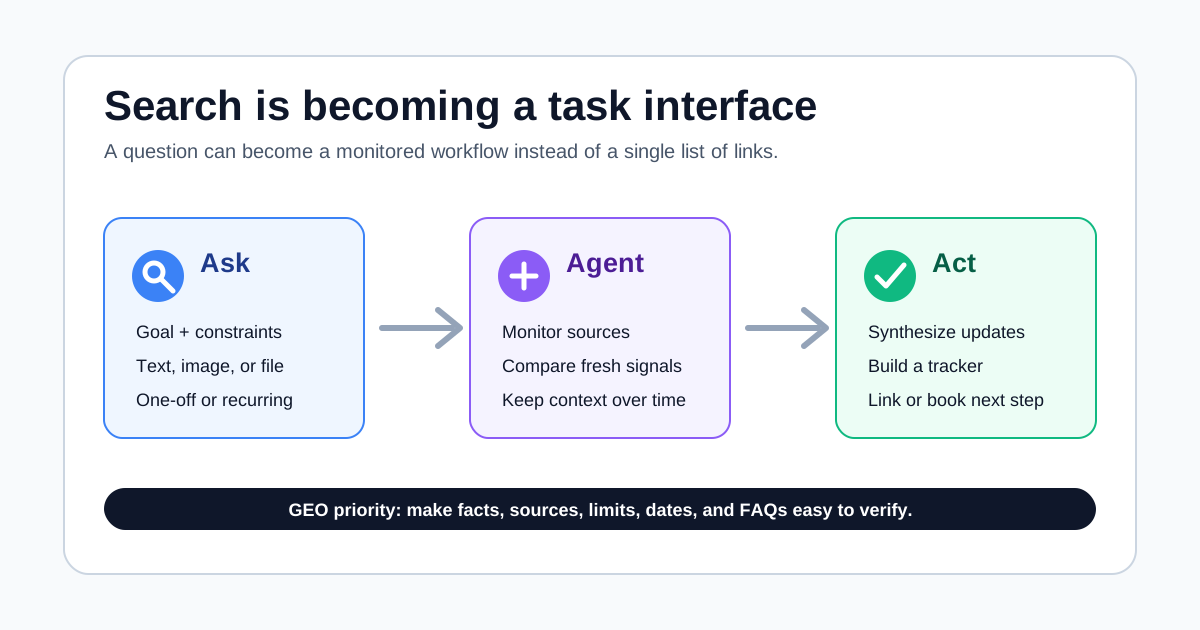
Google Search agents are not simply another AI answer box inside search results. They point to a bigger shift: Search is becoming a task interface. Instead of asking once and clicking through links, a user can ask Search to monitor information, synthesize sources, generate a useful interface, help with a booking flow, or build a tracker for an ongoing task.
For content sites, this is a practical GEO signal. Articles still need to be good for human readers, but they also need to be easy for AI agents to parse without losing the source, limits, date, and uncertainty. The unit of discovery may become less like a page title and more like a set of well-structured facts, definitions, comparisons, and FAQ answers.
This does not mean SEO is dead. It means SEO needs an additional layer. SEO helps content get crawled, indexed, and matched to intent. GEO helps content survive AI search, agent summaries, and task-oriented interfaces without being flattened into a vague, sourceless paragraph.
What Google Announced
At I/O 2026, Google described several Search changes that matter for AI search strategy.
| Confirmed Signal | Source | Why It Matters |
|---|---|---|
| Google said Search is entering an era where users can create, customize, and manage multiple AI agents in Search | Google Search I/O 2026 announcement | Search is moving from one-off queries toward ongoing tasks. |
| Information agents can monitor the web, news, social posts, and fresh data for user-defined questions, then send synthesized updates | Google Search I/O 2026 announcement | This is close to delegated, continuous searching. |
| Google said information agents would launch first for Google AI Pro and Ultra subscribers in summer 2026 | Google Search I/O 2026 announcement | Access is staged, so this should not be described as universally available. |
| Search is expanding agentic booking for local experiences and services | Google Search I/O 2026 announcement | Search is moving closer to action, not only information retrieval. |
| Search will use Antigravity and Gemini 3.5 Flash capabilities for generative UI, simulations, dashboards, trackers, and mini apps | Google Search announcement and Developers recap | Search results may become generated tools, not just lists of links. |
| Google Developers and Chrome announcements also point to WebMCP, Modern Web Guidance, and Chrome DevTools for agents | Google Developers and Chrome announcements | The shift is broader than a single Search feature. |
The core direction is confirmed by official Google sources. The unresolved parts are availability, regional rollout, final product shape, and actual impact on content traffic.
Why It Matters
Classic search is mostly a single request. You type a query, get links, open pages, compare sources, and decide what to do. AI Overviews already moved some answers directly into the results page. Search agents go further: they are designed for tasks that require monitoring, comparison, waiting, synthesis, and action.
For users, the value is obvious. Apartment hunting, service booking, product tracking, research monitoring, and local planning all involve repeated searches. An information agent can turn those repeated searches into a background workflow.
For publishers and independent sites, the picture is more complicated. The old question was: can people find my page? The new question is: if an agent extracts five facts from my page, will it extract the right five? If it compresses my argument into one sentence, will the limits and uncertainty survive? If the user never opens the page, will my source and brand still be visible?
That is where GEO becomes useful.
What This Means for Content Sites
GEO is not about stuffing articles with phrases that sound friendly to AI. It is about making content more verifiable, more modular, and harder to misread.
For technical content sites, the first useful changes are simple:
| Content Block | Purpose | Practical Format |
|---|---|---|
| Short conclusion | Give humans and agents the main judgment quickly | Answer the reader’s core question in the first 100 words. |
| Definitions | Prevent terms from being mixed together | Define Search agents, information agents, GEO, and related terms plainly. |
| Fact table | Tie claims to sources | Put important claims next to their source and boundary. |
| Uncertainty section | Stop inference from becoming false certainty | List rollout, region, pricing, and traffic-impact unknowns separately. |
| FAQ | Cover real long-tail questions | Use questions readers would actually ask. |
| Update date | Add a time boundary | Keep updatedDate and next-watch items visible for fast-moving topics. |
This structure does not guarantee more traffic. It does reduce a specific risk: your article being read by an AI system and turned into a generic summary with no source, no boundary, and no useful context.
What This Means for Developers
Search agents also point to a product-design shift. Web products may increasingly need to work as task environments that agents can understand and operate.
Google’s developer recap mentions Antigravity, Managed Agents, Android CLI, WebMCP, Modern Web Guidance, Chrome DevTools for agents, and related tooling. The common signal is that pages, tools, APIs, and documentation may need to be legible to agents, not only visible to humans.
Small teams do not need to rebuild everything as agent-first software tomorrow. A more practical starting point is:
- Keep documentation pages structured with clear headings, steps, errors, and version notes.
- Make forms, buttons, states, and error messages semantically clear.
- Give important workflows linkable, recoverable, and auditable states.
- Separate facts, limits, inference, and opinion in public content.
- Avoid hiding critical information only in images, client-only UI, or login-gated flows.
These changes are good for users anyway. In an agentic web, they also make it easier for software assistants to help users correctly.
What Is Still Uncertain
First, rollout is staged. Google described some features for Google AI Pro and Ultra subscribers, some for U.S. availability, and some for future windows. A responsible article should not treat the full roadmap as globally available today.
Second, traffic impact is not known yet. AI search may send higher-intent clicks to some sites while reducing shallow informational clicks for others. The only useful answer is measurement: Search Console, Cloudflare Analytics, referrers, language paths, and page-level query changes.
Third, source visibility remains an open question. Content sites can structure their work well, but they cannot assume platforms will always cite original sources prominently.
Fourth, personalization has privacy boundaries. Google described Personal Intelligence with connected apps and user control. That is a product direction, not a guarantee that every user or region will use it in the same way.
If your question is about assistants accessing phone context and acting across apps, rather than providers using search data, read the separate EU Android AI interoperability and permissions guide. The two measures have different scopes.
What To Watch Next
The useful thing to watch is not whether every new Search feature sounds novel. It is whether these features change how people discover information, trust sources, and complete tasks.
Readers should watch four signals:
- Whether Search agents expand to more countries, languages, and account tiers.
- Whether AI summaries and agent updates show original sources more consistently.
- Whether content sites see fewer clicks, different clicks, or higher-intent visits from Google.
- Whether developer tools, browsers, and website forms become easier for agents to call and continue as tasks.
If Search is becoming a task interface, a content site should become more than a stream of posts. It should become a maintained set of source-backed knowledge blocks that humans and agents can revisit without losing the facts.
FAQ
How are Search agents different from AI Overviews?
AI Overviews summarize a search result. Search agents are closer to recurring workflows: monitoring changes, synthesizing sources, generating updates, helping with actions, and creating dashboards or trackers for ongoing tasks.
Does GEO replace SEO?
No. SEO still handles crawlability, indexing, titles, site structure, page experience, and search intent. GEO adds a layer that makes content easier for AI search, agents, and answer systems to understand and cite accurately.
Should small websites rewrite everything now?
No. Start with high-value articles. Add a clear conclusion, definitions, fact tables, source links, uncertainty, FAQs, and update dates. Do not make the article worse for humans just to chase AI systems.
Will Search agents reduce website clicks?
That is possible, but it is not proven for every site or query class. Watch real data: Search Console impressions and clicks, Cloudflare referrers, cited pages, engagement proxies, and language-path performance.
Does this article rely on rumors?
No. The main claims come from Google’s official Search, Developers, Chrome, and I/O announcements. The traffic and GEO recommendations are inferences based on those announcements, and they are labeled as strategy rather than confirmed outcome.