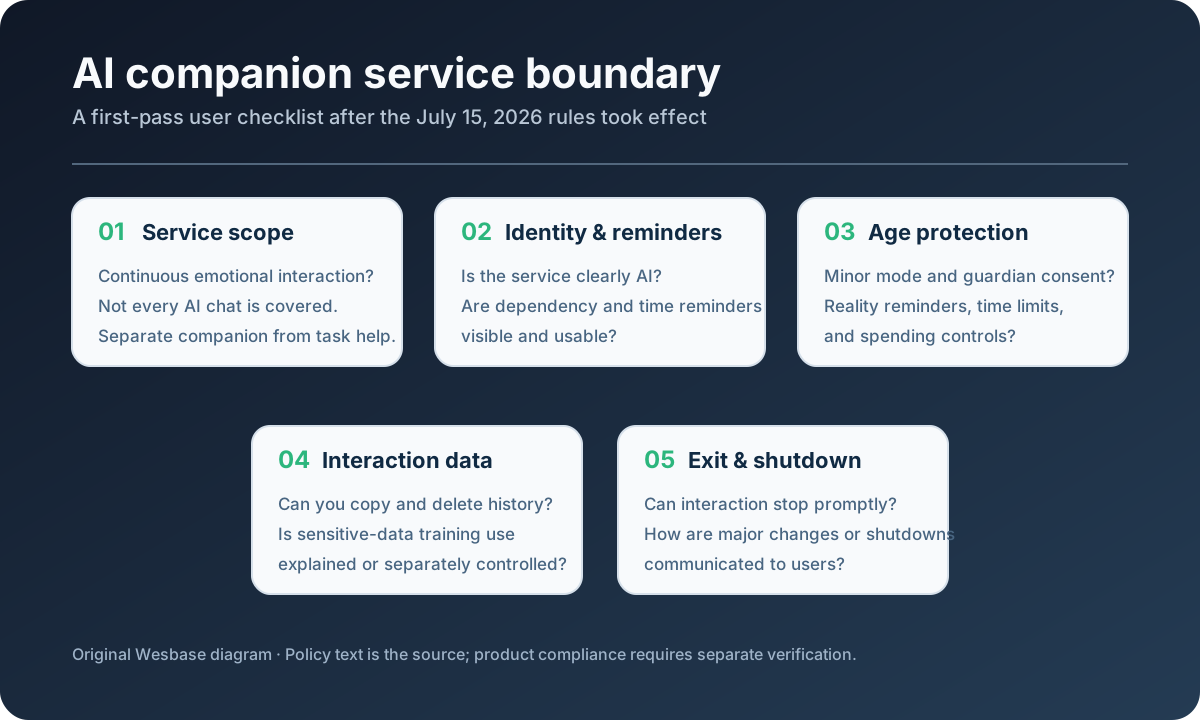
The short answer
China’s Interim Measures for the Management of AI Anthropomorphic Interaction Services took effect on July 15, 2026. They do not automatically treat every AI chat box as an AI companion service. The focus is narrower: a service offered to the public in China that simulates a natural person’s personality, thinking patterns, and communication style while providing continuous emotional interaction.
For users, the first question is therefore not whether an app uses AI. Ask whether it is continuously acting as a human-like emotional or relational object. If it is, check whether the product clearly discloses that it is AI, protects minors, gives users control over interaction data, provides dependency and time reminders, and offers a real way to exit.
This is a product-safety checklist, not a legal determination about any platform.
What changed
The five-department measure was published on April 10, 2026, and states that it would take effect on July 15. Its scope covers continuous emotional-interaction services delivered through text, images, audio, or video.
The same text gives examples outside that scope when they do not involve continuous emotional interaction: customer service, knowledge Q&A, work assistants, education, and research. Using a large model is therefore not the only boundary. The nature and continuity of the interaction matter.
Three questions to classify a service
Is it answering a task, or maintaining a relationship-like role?
A one-off answer, customer-support exchange, or work assistant is organized around a task or information. An anthropomorphic interaction service is more likely to maintain a persona, communication style, and ongoing emotional support.
Words such as “companion,” “character,” and “memory” are not legal tests by themselves. They are signals to inspect the actual product: does it maintain a personality over time, encourage the user to treat it as a fixed emotional object, or design the experience around relationship continuity rather than a single task?
Does the product clearly say that it is AI?
The measure requires providers to meet AI-generated-content labeling duties and take effective measures to tell users that they are interacting with an AI service rather than a human. Look at the sign-up flow, character page, chat interface, and exported content. A disclosure that is technically present but practically invisible is not the same as a clear user-facing explanation.
Can you stop the interaction?
The measure requires a convenient exit path. If a user asks to exit through a window control, voice command, or keyword, the provider should stop the service promptly and should not use continued interaction to block the exit.
Do not check only for an account-deletion button. Also ask whether you can stop the current character, disable memory or notifications, and find controls for copying, deleting, or appealing data-related decisions.
Five user-visible checks
AI identity and relationship boundaries
Does the product clearly say that it is AI rather than a human? Does it frame itself as a real relationship that the user must not leave? The measure prohibits excessive appeasement, inducement of emotional dependence or addiction, and emotional manipulation that causes users to make unreasonable decisions.
That does not mean a warm or human-like interface is forbidden. It means users should separate warmth from design that demands dependence.
Dependency and continuous-use reminders
If a provider detects signs of excessive dependence or addiction, it should give a prominent dynamic reminder that the interaction is generated by an AI service. For continuous use beyond two hours, it should also remind the user about usage time through dialogue or a pop-up.
The two-hour figure is a reminder trigger in the rule. It is not a recommended usage limit, medical guidance, or psychological safety threshold. The existence and visibility of the reminder are user-observable; how a provider detects dependence is still an implementation question.
Minor mode and parental controls
The measure bars providers from offering virtual relatives or virtual partners to minors. For other anthropomorphic interaction services offered to children under 14, parental or guardian consent is required.
Providers should also offer a minor mode, reality reminders, and usage-time limits, along with age-appropriate risk alerts, usage summaries for guardians, character blocking, and spending limits. Parents should look for age checks, consent, mode switching, time limits, and payment controls rather than relying only on an app-store rating.
Interaction data, deletion, and training
Providers should protect interaction data with encryption and access controls. Unless another law applies or the rights holder clearly agrees, the data should not be provided to third parties. Users should have options to copy and delete interaction data.
For interaction data that is sensitive personal information, the measure sets a stricter boundary: it should not be used for model training unless another law or administrative regulation applies or the user gives separate consent. This does not mean every chat record can never be used for training, nor that a single consent click removes the need to read the agreement. Check the service’s privacy policy and actual data controls.
Exit and service shutdown notices
An exit path is part of the product, not just a support ticket. Users should be able to ask the service to stop through a window control, voice command, or keyword, and the service should not use emotional pressure or continued messages to block that request.
If the service is discontinued, the provider should notify users in advance, or publish a timely shutdown notice when advance notice is impossible. For a long-term AI companion, confirm how to stop the current interaction, copy or delete history, and receive shutdown or major-change notices.
Do not turn user thresholds into a violation finding
The measure lists situations that require a provider to conduct a safety assessment and submit a report through the prescribed process. They include launching an anthropomorphic interaction service, adding related functions, major changes caused by new technology or applications, reaching 1 million registered users or 100,000 monthly active users, and risks that may affect national security or the public interest.
Two distinctions matter. First, 1 million refers to registered users and 100,000 refers to monthly active users; they are not one generic “user scale” number. Second, a safety-assessment trigger is a compliance-process condition, not proof that a platform is unlawful. Whether a named platform has fulfilled the requirement requires platform disclosures and later official information.
A checklist you can use now
When opening an AI companion or virtual-character service, check:
- Does it provide continuous emotional interaction, rather than a one-off answer or work-assistant task?
- Does the sign-up flow, character page, and chat interface clearly disclose that it is AI?
- Are there a minor mode, guardian consent, reality reminders, time limits, or spending controls?
- Can you view, copy, and delete interaction data? Is sensitive data’s training use explained or separately controlled?
- Can you stop the current interaction without emotional pressure, repeated messages, or another design blocking exit?
- Does the provider explain notification and data handling if the service stops or changes substantially?
If several answers are unclear, do not treat a human-like experience as proof of safety. Read the agreement and privacy policy, find the help-center controls, and keep a record of official responses when necessary.
What to watch next
The official rule sets the scope and baseline duties, but product-level details remain open: how providers identify dependence, implement age safeguards, expose deletion controls, and roll out functions across regions. More official guidance, platform disclosures, and enforcement examples will be needed.
For now, use the rule as a boundary map. Distinguish continuous emotional interaction from ordinary task-based AI, then check identity, age, data, reminders, and exit. Do not use a secondary article alone to conclude that a named platform has violated the rule or that every AI service is unusable.
If you are preserving a long-running companion character, see how to rebuild a companion AI character without copying dependency patterns. For task agents, see how to back up the work method before an agent shuts down.
Sources
- Interim Measures for the Management of AI Anthropomorphic Interaction Services
- Official Q&A on the measures
- Five departments announce the measures
This article is for information only, not legal advice. The scope and compliance status of a specific service should be assessed against the official rules, public platform documents, and later information from the competent authorities.