You ask an AI tool to research a problem. It returns a polished answer, so you save the chat and bookmark three related pages. Two weeks later, when the project needs a real decision, you still have to start the research again.
The missing asset is not information. It is the reason you trusted one number, rejected another option, limited a conclusion to one context, and eventually changed your mind.
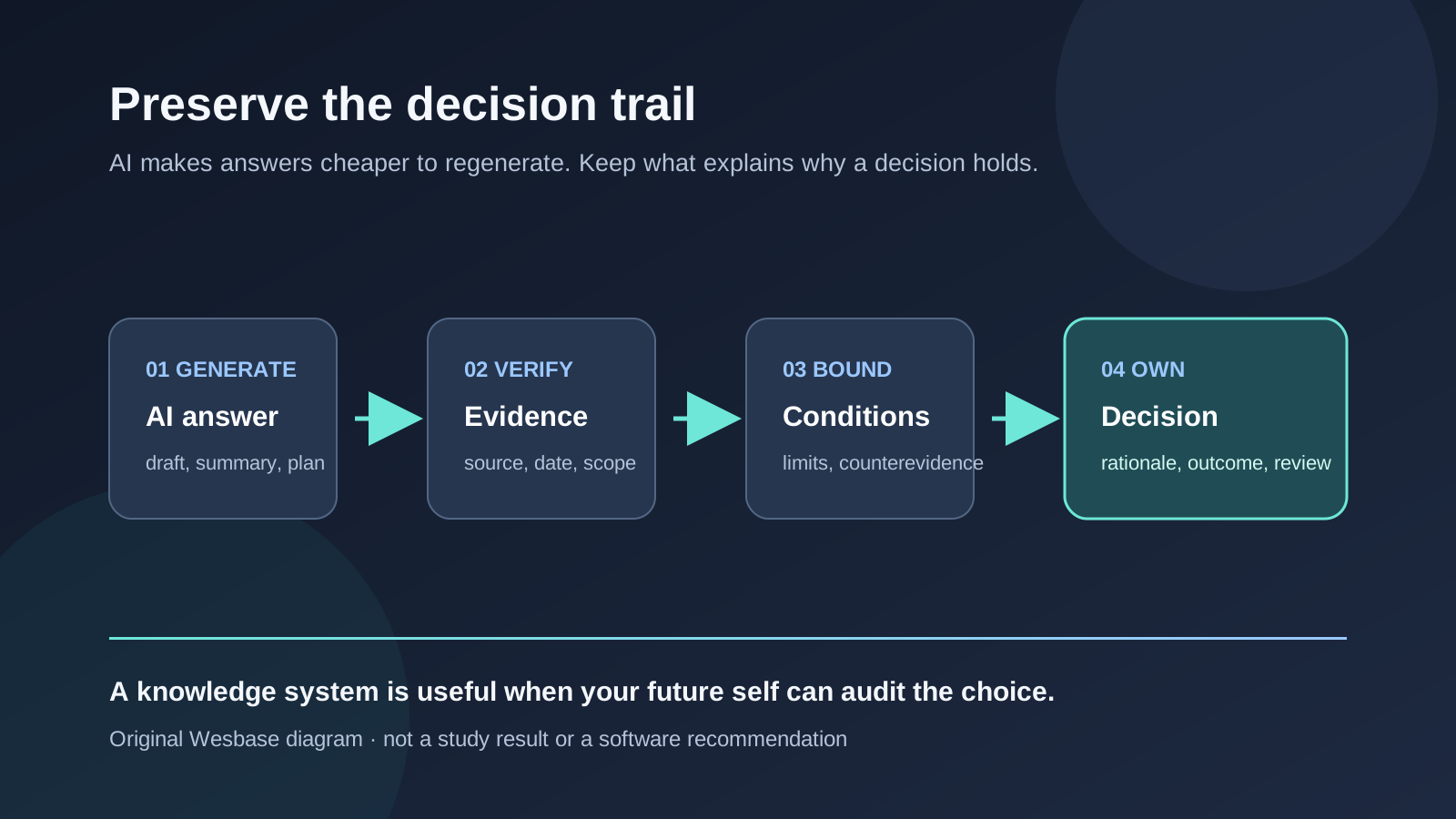
You still need a knowledge system in the AI era. But for work that involves repeated judgment, its job should no longer be collecting answers. It should preserve a decision trail: sources, conditions, counterevidence, human changes, the decision itself, and the signal that should trigger another review.
This does not mean logging every question. A disposable, low-risk lookup can remain disposable. The records worth maintaining are the ones behind conclusions you will reuse, decisions that affect real work, and mistakes that would be expensive.
Do not migrate the whole answer archive
The easiest way to rebuild a knowledge base badly is to copy every AI chat, full web page, and old summary into a new app. That produces a larger archive, not a better system.
I would stop saving four things by default:
- Generic answers that can be generated again. Definitions, ordinary outlines, and context-free advice rarely become scarce assets.
- Polished summaries without sources. If you cannot return to the original evidence, the summary will not support a future decision.
- Duplicate copies of full web pages. Unless a page may disappear or must be retained, save its URL, date, and the note that affected your decision.
- Bookmarks with no next action. If an item changes neither a decision nor a project, do not pretend it will become useful through storage alone.
A randomized experiment published in Science in 2023 helps explain why storing every draft has less value now. Noy and Zhang studied 453 college-educated professionals performing short, occupation-related writing tasks. The ChatGPT group’s completion time fell by about 40%, while independent evaluators rated its output about 18% higher in quality.
Those numbers apply to the experiment’s specific writing tasks. They do not establish a 40% gain across all knowledge work, and the study did not show that factual accuracy or deep understanding improved by the same amount. The narrower conclusion is still useful: producing a plausible first draft has become cheaper. If a draft can be regenerated, it does not automatically deserve permanent storage.
The speed gain is real, and so is the boundary
Faster output does not make every step more reliable.
Dell’Acqua and colleagues ran a preregistered randomized experiment with 758 BCG consultants. Across 18 consulting tasks selected to be inside the capability frontier of the June 2023 version of GPT-4, AI users completed 12.2% more tasks, worked 25.1% faster, and produced significantly higher-quality results.
On one complex task deliberately selected to be outside that frontier, however, AI users were 19% less likely to produce a correct solution than participants without AI. That figure is not a general AI error rate, and it should not be projected onto current models or every profession.
The durable idea is the “jagged frontier.” Tasks that look similarly difficult—and can sit inside the same workflow—may fall on opposite sides of the model’s capability boundary. Fluency alone does not tell you which side you are on.
A 2025 Microsoft Research study gives us another view of that handoff. Researchers surveyed 319 knowledge workers who used generative AI at least weekly and collected 936 real work examples. Greater confidence in AI for a task was associated with less self-reported critical thinking, while greater confidence in one’s own ability was associated with more. Participants described their valuable work shifting toward verifying information, integrating answers, and taking responsibility for the result.
This was a self-reported, correlational survey. It does not prove that AI causes critical thinking to decline. It does suggest that when generation becomes cheaper, human responsibility moves downstream rather than disappearing.
| What the study examined | What it supports | What it does not support |
|---|---|---|
| Short professional writing | AI can reduce first-draft time and improve rated quality in some tasks | Every job gains 40%, or deeper understanding automatically follows |
| A jagged capability frontier | AI’s benefit changes by task and can reverse outside the frontier | AI has a general 19% error rate |
| Knowledge workers’ self-reports | Verification, integration, and stewardship remain human work | AI inevitably makes people less intelligent |
Preserve seven decision assets
If the final answer is no longer the scarce part, what should a personal knowledge system keep? The following fields are my practical design, not a standard directly validated by the cited studies.
- Question: the decision you actually needed to make, not a broad research topic.
- Evidence: original sources, publication dates, metric definitions, and the specific evidence you used.
- Conditions: the version, region, user, time period, and assumptions under which a conclusion holds.
- Counterevidence and alternatives: what challenged the conclusion and why another option was not chosen.
- Human verification: what AI produced and what a person checked.
- Decision and rationale: the selected option and the two or three reasons that mattered most.
- Outcome and review trigger: what happened next and which event should reopen the decision.
A chat archive preserves the sequence of a conversation. A decision log is organized for future reuse. One tells you what the model said. The other tells your future self why it was accepted, limited, changed, or rejected.
For a broader boundary design, see How to Build a Personal AI Agent Stack. To audit which judgments you may already be delegating, see Turn Your Claude Usage Reflection Into a Boundary Checklist.
Rebuild one project in 30 minutes
Do not migrate your whole archive. Pick one project in progress this week—one where you will personally own the final decision.
First 5 minutes: define the decision. Replace “research AI writing tools” with “decide whether to use an AI tool for first-pass summaries in next month’s client-report workflow.” A concrete decision makes irrelevant evidence easier to discard.
Next 10 minutes: keep only decision-changing evidence. Add two to four primary sources, including their dates and definitions. AI can find leads, compare material, and draft notes, but each material claim should remain traceable to its source.
Next 5 minutes: write the conditions and strongest counterevidence. When would the option work? What fact would most seriously challenge it? A record containing only supporting material is advocacy, not a decision trail.
Next 5 minutes: define the human takeover point. State what AI may do and which step requires human verification. For consequential or irreversible actions, a confident tone is not a reason to remove review.
Final 5 minutes: add a review trigger. Avoid “check later.” Use an observable event: a price change, a model update, a policy revision, or two consecutive outcomes outside the expected range.
A reusable decision-log template
# Decision: one sentence describing the choice

- Date:
- Deadline:
- Decision owner:

## Key evidence
- Source / date / metric definition:
- What this evidence supports or challenges:

## Conditions and counterevidence
- Assumptions required:
- Strongest counterevidence:
- Alternative not chosen and why:

## AI and human roles
- What AI generated or organized:
- What a person verified:
- Mandatory human takeover point:

## Decision
- Choice:
- Main rationale:
- Remaining unknowns:

## Outcome and review
- Observed result:
- Review date or trigger:
Suppose you are deciding whether AI should produce first-pass summaries for client reports. The log does not need the full 20-turn conversation. It needs the permitted data boundary, the samples used to judge quality, the error patterns you found, the claims that require comparison with the original document, your final choice, and the result you will review in a month.
When a similar tool appears, you can inspect the previous boundary and outcome instead of rereading every chat.
Three boundaries matter more than the app
First, do not over-document low-risk disposable tasks. Looking up a shortcut or rewriting an ordinary sentence rarely needs a permanent decision trail. Maintenance time is a real cost.
Second, do not put secrets into a “second brain.” Passwords, API keys, client data, undisclosed business information, and personal health or financial details need access rules and minimum exposure. Record the decision boundary without copying sensitive source material.
Third, date every conclusion that can expire. Model capability, price, product functionality, regulation, and market data change. A claim without a date or review trigger can become an old answer that still looks authoritative.
A useful knowledge system is not proof that you collected a lot. It should show what a decision rested on, what it excluded, where a human took over, and which new evidence would justify changing course.
Answers can be generated again. Your decision trail should not have to be rebuilt from zero.
If you use a financial information tool with AI research and scheduled alerts, the Google Finance AI verification matrix is a concrete example: record the source, date, definition, and scope before deciding whether to act.
Sources
- Microsoft Research: The Impact of Generative AI on Critical Thinking: the survey, confidence associations, and shift toward verification and stewardship; not used as causal evidence.
- MIT Economics: ChatGPT productivity in some writing tasks: the 453-person experiment, time and quality results, and its task boundaries.
- Organization Science: Navigating the Jagged Technological Frontier: the 758-consultant experiment, inside/outside-frontier results, and study limits.