Start here: choose one thing you actually own
Do not begin with “all AI news this week.” Choose one API, model, developer tool, repository, or policy area that you maintain, integrate, or evaluate. Register its canonical sources, then use the same fields for two consecutive weeks.
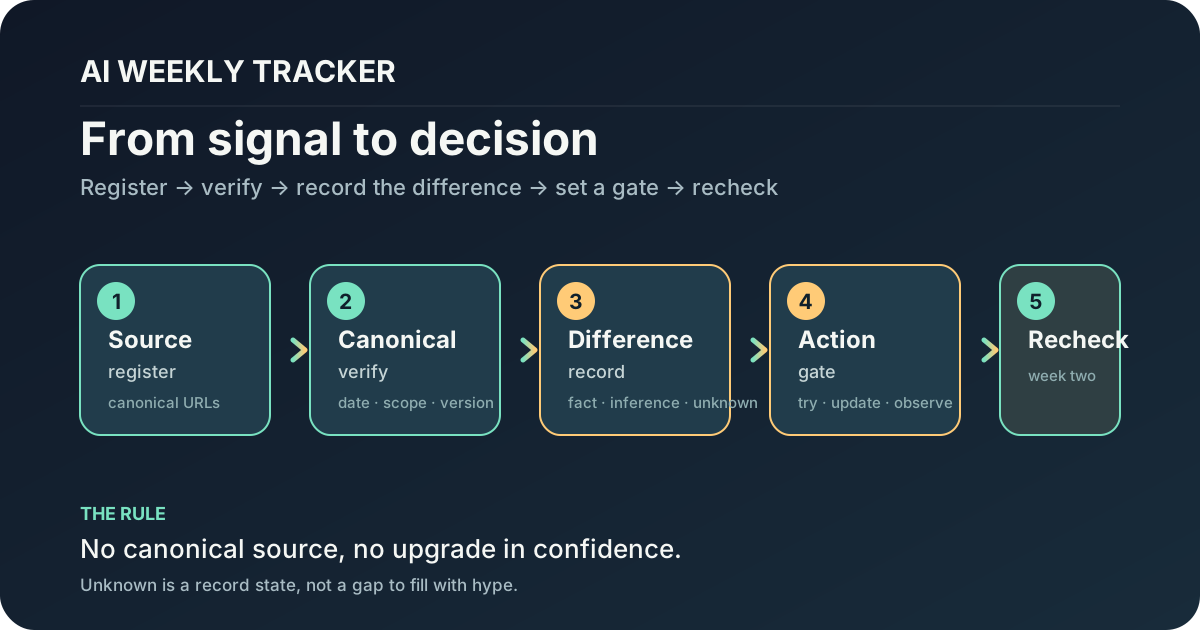
This is not a news roundup. It is a verification and decision workflow: discover a lead, return to the primary page, record the difference, judge whether it affects your work, and set an action or recheck condition. The workflow may reduce repeated judgment and noise, but that is a practical inference to test over two weeks—not an effect proven by the listed sources.
Who this is for—and who it is not for
This process fits people who maintain APIs, model routes, SDKs, IDEs, enterprise tools, or policy checklists. Independent researchers can use the same structure for paper versions, code, and later validation.
It is not a substitute for a “most important AI news” feed, and it cannot predict industry winners. RSS, social posts, media summaries, and rankings can surface candidates, but they are not canonical evidence and cannot raise an item’s action priority on their own.
Match the source to the change
Build a small source register before collecting more links.
| Change type | First place to verify | Fields to capture | What it does not prove |
|---|---|---|---|
| Products, models, and APIs | Vendor changelog and versioned docs | Date, model ID, version, API surface, GA/preview, deprecation date | GA does not mean your account has access or that independent reliability is proven |
| SDKs, IDEs, and repository tools | Official release notes, change page, and docs | SDK version, endpoint, tool, preview/GA, migration guidance | A label does not prove every plan, region, or permission has rolled out |
| Research | Canonical paper record and version page | Identifier, version date, authors, subject, code/data, replication status | An arXiv record does not establish peer review, replication, or a settled finding |
| Policy | Regulator page and later legal text | Jurisdiction, role, obligation date, exceptions, applicability | “Applicable” does not mean every obligation starts everywhere at once |
Google Gemini API’s changelog, the OpenAI API changelog, and Anthropic’s release notes provide dated product-surface changes and availability language from their respective providers. GitHub Changelog uses labels such as New Releases, Improvements, Retired, preview, and GA to help locate changes. Hugging Face Daily Papers is useful for discovery; paper identity and version should be checked on arXiv or the canonical paper page.
If you want to connect source tracking to ownership, boundaries, and tool maintenance, see the Personal AI Agent Stack Boundaries Checklist. The goal is not to add another tool; it is to make responsibility for sources, permissions, and maintenance explicit.
Capture one event without overclaiming
Many bad decisions compress several questions into one sentence: “The model is officially released, so we should switch now.” Separate publication date, effective date, model identity, availability, and workload impact.
## Event
- observed_at:
- source_owner:
- canonical_url:
- source_type: changelog | product-doc | sdk-doc | policy | paper
- published_at:
- effective_at:
- product_or_model:
- model_id_or_version:
- surface: API | app | IDE | enterprise | repository | jurisdiction
- availability: GA | preview | limited | deprecated | retired | unknown
- change_type: new_release | feature | improvement | breaking_change | deprecation | retirement | policy_effective | policy_change | paper_new_version | documentation_only
- source_statement:
- confirmed_fact:
- vendor_or_regulator_statement:
- editorial_inference:
- reader_workload_affected:
- impact_priority: urgent | high | medium | low | unknown
- confidence: high | medium | low
- counterevidence:
- unknowns:
- action: try | update | observe | ignore
- acceptance_test_or_reason:
- owner:
- next_review_at_or_trigger:
Use four epistemic labels explicitly. confirmed_fact is directly visible on the canonical page with date and scope. vendor_or_regulator_statement preserves the source owner’s characterization. editorial_inference is a proposed impact based on your owned workload. unknown means unstated, unchecked, or not reproducible. If a vendor says “production-ready,” preserve that as a vendor statement; do not turn it into independent production reliability.
That is also why the tracker should not become a summary archive. For a related explanation of how sources, conditions, counterevidence, decisions, and review dates form a traceable decision trail, see Decision Trails for Knowledge Systems in the AI Era.
The weekly procedure: fixed inputs, outputs, and stop conditions
1. Freeze the source register
Input: the objects you own and their canonical URLs. Output: a source table with type, owner, check frequency, and last-read time. Stop when every object has at least one source that leads back to the original page. If it does not, record unknown rather than filling the gap with a summary.
2. Use secondary signals for discovery
Input: news, social posts, Daily Papers, or a team message. Output: a candidate list, not a fact list. Stop when every candidate has a canonical URL to open. If there is no original page, leave the item in “pending verification” and keep it out of the action queue.
3. Re-open the canonical page
Input: a candidate and its original URL. Output: an event record with observed_at, published_at, effective_at, model/version, surface, and availability. If date, version, scope, or access conditions are missing, write unknown; do not substitute GA, rankings, or one trial.
4. Write the difference
Input: this week’s and last week’s event records. Output: only additions, changes, withdrawals, deprecations, retirements, or documentation changes, with the comparison version named. If the baseline is unclear, preserve both raw records and mark the difference unknown.
5. Judge the owned workload
Input: the verified event and your workflow. Output: priority, confidence, counterevidence, and a falsifiable inference. “This SDK change may affect our build process” is an inference; a migration note, version difference, or failing test is follow-up evidence. If the only support is heat, ranking, or someone saying “watch this,” keep priority unknown.
6. Pass an action gate
Input: impact, risk, cost, and reversibility. Output: try, update, observe, or ignore, plus an acceptance test or reason. If the workflow, success criterion, permission boundary, and rollback path are unclear, do not make a high-risk update.
An imminent breaking change, retirement, legal or policy effective date, security event, or data-boundary change is an urgent review item. That means prioritizing verification and ownership; it does not mean updating automatically without a test.
7. Recheck in week two
Input: the first action or no-action record. Output: result, counterevidence, remaining unknowns, and the next trigger. Lifecycle, retirement, security, and policy changes deserve an earlier recheck; ordinary observations can use the scheduled date. If two weeks produce no canonical change or workload impact, stop expanding the search.
When to try, update, observe, or ignore
| Action | Minimum condition | Acceptance or stop condition |
|---|---|---|
| try | Canonical source confirmed, relevant workload, reversible risk | Test one real task with a baseline and record failure conditions |
| update | Version, effective date, migration scope, and affected old path are clear | Validate in a reversible environment before widening the change |
| observe | Potentially relevant, but scope, access, cost, or behavior is unknown | Set a date or trigger; “look later” is not a review plan |
| ignore | Only heat or no owned workload impact, with no verified reason to act | Preserve the reason so the same judgment is not repeated next week |
“Everyone is discussing it” is not a priority rule. Priority comes from the workflow you own, error cost, spend, irreversibility, and testability. For agents, connectors, or real-task evaluations, define permissions and acceptance criteria separately; the AI Work Agent Evaluation Checklist is a useful companion.
How to tell after two weeks whether it helps
Do not count how many updates you collected. Compare the two runs: retrieval dates, canonical URLs opened, captured change text, fact/statement/inference/unknown classifications, action or no-action decisions, observed results, and next triggers. The useful question is whether week two made it easier to answer “what changed, does it affect me, and what should I do?”
Noise reduction remains a testable inference. If the record grows while repeated searching and mistaken escalation do not decline, narrow the source list, reduce fields, or change the review interval. Do not respond by subscribing to more feeds.
A checklist you can finish today
- Choose one AI product, model, tool, or policy area you own.
- Register at least one canonical source, its type, and its owner.
- Copy the event template and record observed_at and the page’s date.
- Keep secondary leads separate from confirmed facts.
- Write
unknownfor missing version, scope, effective date, permission, or behavior. - Write one workload impact inference and one bounded acceptance test.
- Set a week-two review date or trigger.
Do not do this
Do not treat a media summary as final evidence, rewrite a vendor’s GA or production-ready language as independent performance, call a preprint a replicated result, or batch-update a system without version, scope, and rollback information. If an item cannot be traced to a canonical source, leave it as a candidate or unknown instead of completing the story with popularity.
FAQ: interpretations that commonly go too far
Does GA mean everyone can use it?
No. Check the surface, plan, region, account, permission, and rollout. GA in a vendor changelog is the provider’s availability statement; it does not automatically describe your environment.
What if a model alias changes?
Record the alias, concrete model ID or snapshot, surface, and effective date separately. An alias may move to a different snapshot, so it is not a fixed model identity.
Can a vendor changelog prove reliability?
No. It proves that the vendor recorded a change on a date. Whether it is stable and useful on your workload requires a bounded independent test.
Can I write that an arXiv preprint “proves” something?
No. Record its identifier, version date, authors, and subject, then separately check peer review, code/data, replication, and later versions.
Can I act as soon as a policy page says “applicable”?
Not without more fields. Record jurisdiction, role, exceptions, effective date, and later legal text. This workflow provides tracking fields, not legal advice.
When should an item remain unknown?
When the canonical source does not establish the version, effective date, scope, or access condition, or when the behavior cannot be reproduced in the relevant account, region, permission set, or product surface. Unknown is a useful record state—not an invitation to guess.
What to watch next
Recheck when canonical URLs, changelog structures, or the recommended fields materially change. Review at least quarterly, and sooner after a missed source update or a lifecycle, security, or policy change. Start with one object today; after two weeks, preserve the result, counterevidence, unknowns, and next trigger before expanding the register.
Sources and scope
All source pages below were reopened and checked on 2026-07-26. Changelogs, release notes, and policy pages change over time; later records must preserve their own retrieval date and page scope.
- Products and APIs: Google Gemini API changelog, OpenAI API changelog, and Anthropic release notes. These record each source owner’s changes and availability language, not independent reliability tests.
- Developer tools: GitHub Changelog. Labels and rollout information still require opening the linked change page.
- Research discovery: Hugging Face Daily Papers is a lead source; paper identity and version belong on arXiv CS.AI recent.
- Policy: the European Commission AI Act page. Jurisdiction, role, exceptions, and later legal text remain required fields.