Bottom line
Claude’s usage reflection beta is worth using as an AI habit review, but it is not a productivity audit, psychological diagnosis, or complete picture of who you are.
Anthropic announced the feature on July 9, 2026. It lets users review topics, task types, and usage patterns across 1, 3, 6, or 12 months, then consider their collaboration with AI through Delegation, Description, Discernment, and Diligence. Its real value is not telling you how much AI you used. It is making a harder question visible: which tasks made you more capable after delegation, and which tasks only became faster while your judgment got thinner?
What Claude’s reflection actually shows
Anthropic says the reflection dashboard is available in Settings on Claude for web or the desktop app. It summarizes topics, usage patterns, and the kinds of tasks a user commonly works through. The review window can be 1, 3, 6, or 12 months.
The report also uses Anthropic’s 4D AI Fluency Framework. Delegation is deciding when and how to hand work to AI. Description is expressing goals and constraints. Discernment is assessing whether an output is useful. Diligence is taking responsibility for how AI is used and what happens next. These are not presented as a universal scientific test; they are a vocabulary for reviewing your own habits.
The product also offers quiet hours and break nudges. They are dismissible reminders, not hard limits. That distinction matters: the feature can help you notice a pattern, but it does not decide what a healthy or reasonable amount of use is.
Confirmed facts, inferences, and unknowns
| Type | What we can say | What it does not prove |
|---|---|---|
| Confirmed | Beta reviews topics and task patterns over 1, 3, 6, or 12 months | It does not cover every form of AI use |
| Confirmed | Free, Pro, and Max users can use it with Memory enabled | Every account will receive it at the same time |
| Confirmed | Incognito chats are excluded and health-integration conversations are omitted | Every sensitive subject is guaranteed to disappear |
| Confirmed | Underlying files from connected tools are not pulled into the reflection | A conversation summary cannot mention a sensitive topic |
| Inference | Reflection may help users adjust delegation and review habits | There is no public causal evidence that it improves productivity or wellbeing |
The safest interpretation is: “This is a visible pattern in my Claude activity,” not “This is my complete work style.” If you spend significant time in other AI tools, coding agents, phone assistants, or local models, Claude’s report will not automatically represent those activities.
The 4D checklist: turn the report into action
1. Delegation: what did I hand over?
Classify by risk, not by task count. Organizing public information, rewriting a draft, and generating brainstorming questions are usually low-risk delegation. Deciding a customer commitment, financial action, medical conclusion, or account permission is high-risk delegation.
Ask one practical question: if Claude disappeared today, could you still explain why the decision was sound? If not, save the criteria, sources, and review notes—not only the final text.
2. Description: did I make the goal clear?
If the report shows repeated context-setting, the issue may not be model capability. Your work context may simply be unstructured. Put the goal, audience, constraints, forbidden moves, and acceptance criteria into a reusable template. That often beats adding another long prompt.
3. Discernment: am I evaluating or accepting?
Smooth language is not proof. For policy, prices, health, legal, or technical configuration questions, ask Claude for sources, dates, assumptions, and uncertainty, then check the key original material. Discernment is not giving an answer a feeling score; it is knowing which claims still lack evidence.
4. Diligence: who owns the outcome?
AI can generate a suggestion, but it cannot take responsibility for sending the email, merging the code, publishing the article, or making an irreversible change. Keep the final step human and use a small release checklist: facts, permissions, privacy, sources, affected people, and a rollback path.
Try now, use cautiously, or wait
| Choice | Good fit | Do first |
|---|---|---|
| Try now | Individuals who want a baseline of their AI topics and delegation habits | Generate one report and mark three frequent topics and three high-risk tasks |
| Use cautiously | People handling work, emotional, health, or private material | Read the privacy and exclusion details before interpreting the report |
| Wait | Teams needing enterprise audit, cross-tool coverage, or verified metrics | Do not treat a personal beta as a governance system |
A low-risk rollout starts with public information and writing tasks, then moves to personal workflows. Only after that should you consider whether more private material belongs in an AI conversation. If a topic appears in the report, that does not mean you should keep delegating it; it means you should check whether the delegation still matches your goal.
Five checks before making AI a daily default
- Check scope: the report covers relevant Claude activity, not every AI tool you use.
- Check exclusions: incognito, connected-tool files, and health integrations have different boundaries.
- Check evidence: separate “I often do this” from “I do this better now.”
- Check risk: health, money, law, customer data, and account actions need extra review.
- Check reversibility: keep human confirmation and a rollback path for public or external actions.
FAQ
Where can I find Claude’s reflection feature?
Anthropic says the beta appears in Settings on Claude for web or the desktop app. Free, Pro, and Max users need Memory turned on to generate a report.
Does Claude’s reflection read my files?
Anthropic says it does not pull underlying files from connected tools. Incognito chats are excluded and health-integration conversations are left out entirely, although sensitive conversations may appear at a high level.
Can the reflection prove that I am more productive?
No. It can show topics and usage patterns, but it cannot by itself prove better productivity, learning, or wellbeing.
What should remain a human decision?
Keep human review for health, financial, legal, customer, account, relationship, and irreversible actions, and ask for sources, dates, and uncertainty.
Image and source notes
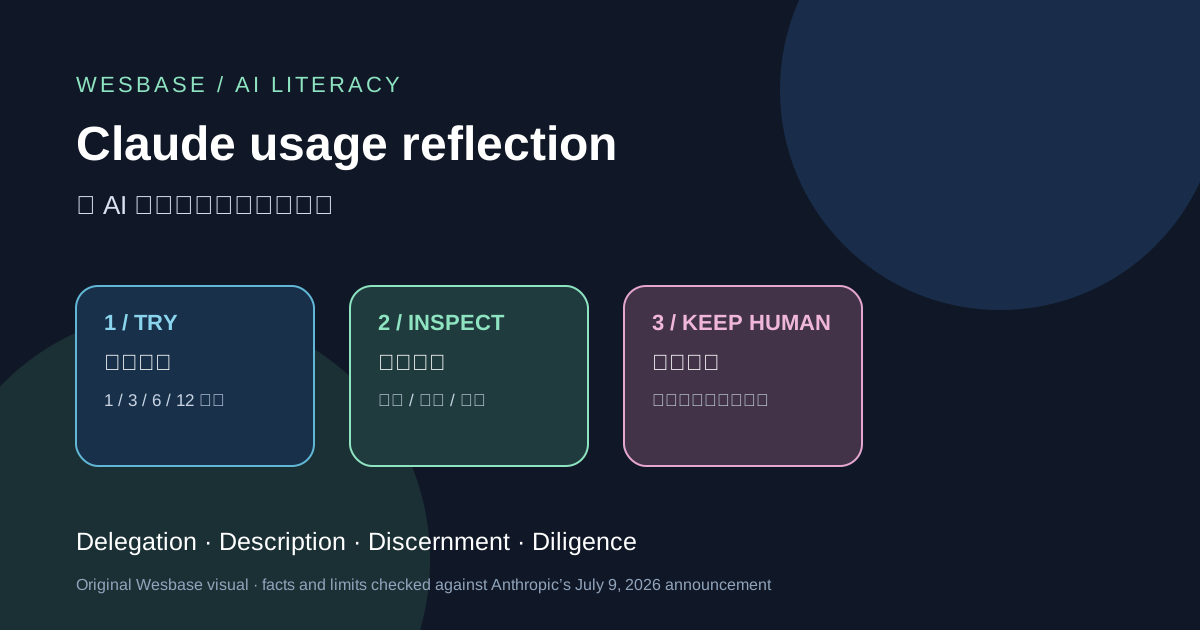
The cover is an original Wesbase AI literacy checklist. It uses no Anthropic logo, Claude screenshot, or media image. Product facts come from Anthropic’s July 9, 2026 announcement and newsroom. Claims that the report is not a productivity audit and cannot prove improved efficiency are cautious inferences from the public feature scope, and are labeled as such in the article.