Start With the Next 20 Minutes
If you have task agents in Doubao or Qwen, do not start by hunting for the perfect replacement app. Start by listing the agents you actually depend on.
Prioritize these first:
| Agent type | Common use | Why it matters |
|---|---|---|
| Writing and ideation | Titles, outlines, scripts, newsletters | The useful part is often the tuned voice and structure |
| Research sorting | Web summaries, meeting notes, course notes, PDFs | The output format matters as much as the answer |
| Study planning | Vocabulary, interview prep, error reviews | Personal progress and feedback rules can be lost |
| Work assistant | Weekly reports, customer replies, sales drafts | Stability matters more than creativity |
| Buying or decision aid | Phone, laptop, tool or travel comparisons | The value is in the decision criteria |
For each agent, ask one question: if this stopped working tomorrow, would I miss the prompt, the knowledge files, the examples, or the output format most?
What Happened
Multiple public reports say ByteDance’s Doubao and Alibaba’s Qwen have notified users that agent-related features will be discontinued around mid-July 2026. Eastmoney, citing The Paper, reported that Doubao’s agent feature is scheduled to go offline on July 15, 2026, and that related data will no longer be viewable or recoverable inside Doubao after October 15. Reports also say Qwen has urged users to save important agent configurations and conversations through copying, screenshots or conversation export. TechNode, Tencent News and Sina Finance have reported the same broad shutdown signal.
Separate facts and inference here. The confirmed part is that platforms are withdrawing or changing user-created agent features and telling users to back up data. The inference is that the timing overlaps with China’s Interim Measures for the Management of Anthropomorphic AI Interactive Services, which also take effect on July 15, 2026. That overlap matters, but it does not prove that regulation is the only cause.
For task-agent users, the practical issue is simpler: do you still own the working method you spent time tuning?
Task Agents Need a Different Backup Method
Companion agents are about persona, tone, lightweight memory and emotional boundaries. That is why the companion-agent migration plan should not copy every old conversation. See the related Chinese and English companion-agent guide on this site for that scenario.
Task agents are different. Their value is not who they sound like. Their value is what they can reliably do.
Most task agents have four layers:
| Layer | What to preserve | Why it helps migration |
|---|---|---|
| Task definition | What it does and refuses to do | Keeps the new version from drifting |
| Input material | Usual documents, formats and constraints | Tells the new model where to start |
| Output contract | Tables, checklists, email drafts, JSON, Markdown | Keeps the result usable |
| Quality checks | Banned moves, review steps, failure examples | Prevents polished but unusable answers |
That means a useful backup is not a giant archive of old chats. It is a portable work package.
The One-Hour Backup Kit
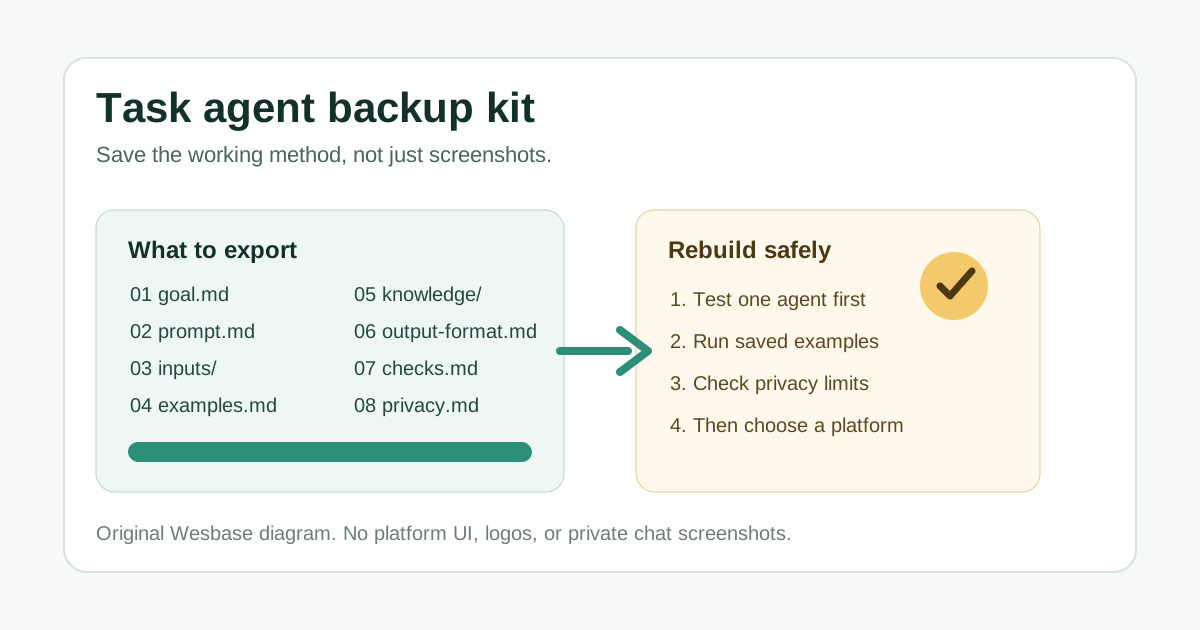
Create one folder for each important agent:
agent-backup/
  weekly-planner/
    goal.md
    prompt.md
    inputs/
    examples.md
    knowledge/
    output-format.md
    checks.md
    privacy.md
1. goal.md: Define the Job in One Paragraph
Do not write only “weekly report assistant.” Make it executable:
# Goal

Turn my meeting notes, task list and project updates into a Chinese weekly report under 500 words.

## Good output
- Completed work first
- Risks and blockers second
- Next week's plan last
- Calm tone, no exaggerated claims

## Out of scope
- Do not invent progress
- Do not mention sensitive customer names
- Do not write performance-review bragging
This file keeps the boundary portable across platforms.
2. prompt.md: Save the Rules as Text
Screenshots can help, but text is what you can reuse.
Split the prompt into:
| Section | Content |
|---|---|
| Role | The working role the agent plays |
| Task | What it must complete each time |
| Constraints | No fabrication, no leaks, no overpromising |
| Output | Format, language, length and table rules |
| Review | What it checks before answering |
If the old platform does not expose the full prompt, copy what you can see and reconstruct the missing rules from two or three successful conversations.
3. inputs/: Keep Samples, Not Everything
A task agent is driven by input. Save at least three kinds of samples:
| Sample | Why it matters |
|---|---|
| Typical input | Recreates the everyday workflow |
| Hard input | Tests the edge case |
| Failure-prone input | Shows what guardrails you need |
Do not migrate every old conversation. Old chats often contain account names, phone numbers, customer data, location, finance, health, family or unreleased project details. A task-agent migration needs examples, not a full diary.
4. examples.md: Save Good and Bad Outputs
Saving only good answers is not enough. A task agent can become worse on a new platform by becoming more verbose, changing the table, skipping review questions or refusing too much.
Use this format:
# Good example

Input: ...
Output: ...
Why it works: clear structure, no fabrication, actionable next step.

# Bad example

Input: ...
Output: ...
Why it fails: missed risk, turned inference into fact, unusable format.
This becomes your test set when you switch models, platforms or prompts.
5. knowledge/: Recover the Source Material
If the agent depends on a knowledge base, save the original files before saving summaries.
Common source types:
| Type | Suggested format |
|---|---|
| Product notes | Markdown or PDF |
| Course notes | Markdown or TXT |
| Support scripts | CSV or Markdown |
| Glossary | CSV or Markdown table |
| Project background | README.md |
If bulk export is not available, preserve the most important files, URLs and folder structure first. Do not upload copyrighted, customer-confidential or unclear-source material to a new platform just because migration is urgent.
6. output-format.md: Preserve the Deliverable
For many task agents, the best feature is not the model. It is the output shape.
For a customer-reply agent, the contract might be:
## Output format

1. Customer intent: one sentence
2. Risk level: low / medium / high
3. Reply draft: 120 words max
4. Do-not-say list: phrases to avoid
5. Need human review: yes / no, with reason
Without this file, the new agent may be correct but unusable.
7. checks.md: Write the Review Rules
Task agents should not be trusted because an answer looks polished. Save a review checklist:
| Check | Question |
|---|---|
| Facts | Did it turn guesses into facts? |
| Sources | Are key claims tied to input or a source? |
| Format | Can the answer be pasted into the target tool? |
| Privacy | Did it expose personal, customer or company data? |
| Boundary | Did it give medical, legal, financial or unsafe advice? |
| Gaps | Did it say what is missing when inputs are incomplete? |
This checklist is often more important than another clever prompt.
8. privacy.md: Decide What Never Moves
Every agent should have a do-not-migrate list:
# Do not migrate

- ID numbers, passports, addresses, phone numbers
- Accounts, passwords, verification codes, API keys
- Medical records, medication, mental-health crisis text
- Bank, tax and transaction details
- Customer names, contracts, quotes, unreleased project data
- Private relationship, family or raw emotional chat logs
For sensitive work, prefer redaction, local processing or summaries over uploading raw data to another service.
Choose the Rebuild Path by Risk
Only choose a new platform after the backup exists.
| Scenario | Safer starting point | Why |
|---|---|---|
| Light personal task | Normal chat plus Markdown templates | Cheap and easy to test |
| Multi-step content workflow | A workflow tool such as Coze | Better for nodes, tools and orchestration |
| Team internal app | A controlled app platform such as Dify | Better for permissions and knowledge bases |
| Document Q&A / RAG | A FastGPT-style knowledge-base tool | Better for retrieval workflows |
| High-privacy work | Local files plus a controlled model | Reduces sensitive-data exposure |
Do not migrate every agent at once. Pick one important, easy-to-evaluate agent. Run three saved inputs. If output quality, format and privacy checks pass, migrate the next one.
Confirmed, Unconfirmed and Uncertain
Confirmed: July 15, 2026 is the recurring shutdown date in public reports, and it is also the effective date of China’s anthropomorphic AI interaction rules. Multiple reports say Doubao and Qwen told users to save agent configurations and important conversations.
Unconfirmed: exact export paths and formats can differ by app version, account, region and agent type. Some reports mention July 10 for Qwen anthropomorphic interactive and user-created agents, while others mention July 15 for the broader agent service. Use the latest in-app notice as the operational source of truth.
Avoid this misunderstanding: task agents are not the same as every regulated human-like AI service. The new rules focus on anthropomorphic, emotionally continuous and dependency-forming interaction risks, especially around minors. Productivity assistants, knowledge-base tools and ordinary workflow helpers still have room, but platforms are likely to design them with clearer boundaries.
Minimal Checklist
If you only do one thing today, do this:
- List your three most important task agents.
- Save
goal.mdandprompt.mdfor each. - Save three input samples and two good outputs.
- Download or copy the knowledge files they depend on.
- Write five review checks in
checks.md. - Remove sensitive raw text and keep redacted examples.
- Test the package in a normal chat before uploading everything to a new platform.
The button inside one app is not the asset. The method is. Once the method is portable, you can rebuild it in the next tool.