Start with the decision: route workloads, do not rank models
This guide compares gemini-3.6-flash and gemini-3.5-flash-lite through the Gemini API. As of 2026-07-24, the Gemini API model catalog lists both as Stable, and Google’s latest-model documentation describes both as GA and ready for production use. Both were announced on 2026-07-21. Stable is a current status, not a promise that behavior will never change.
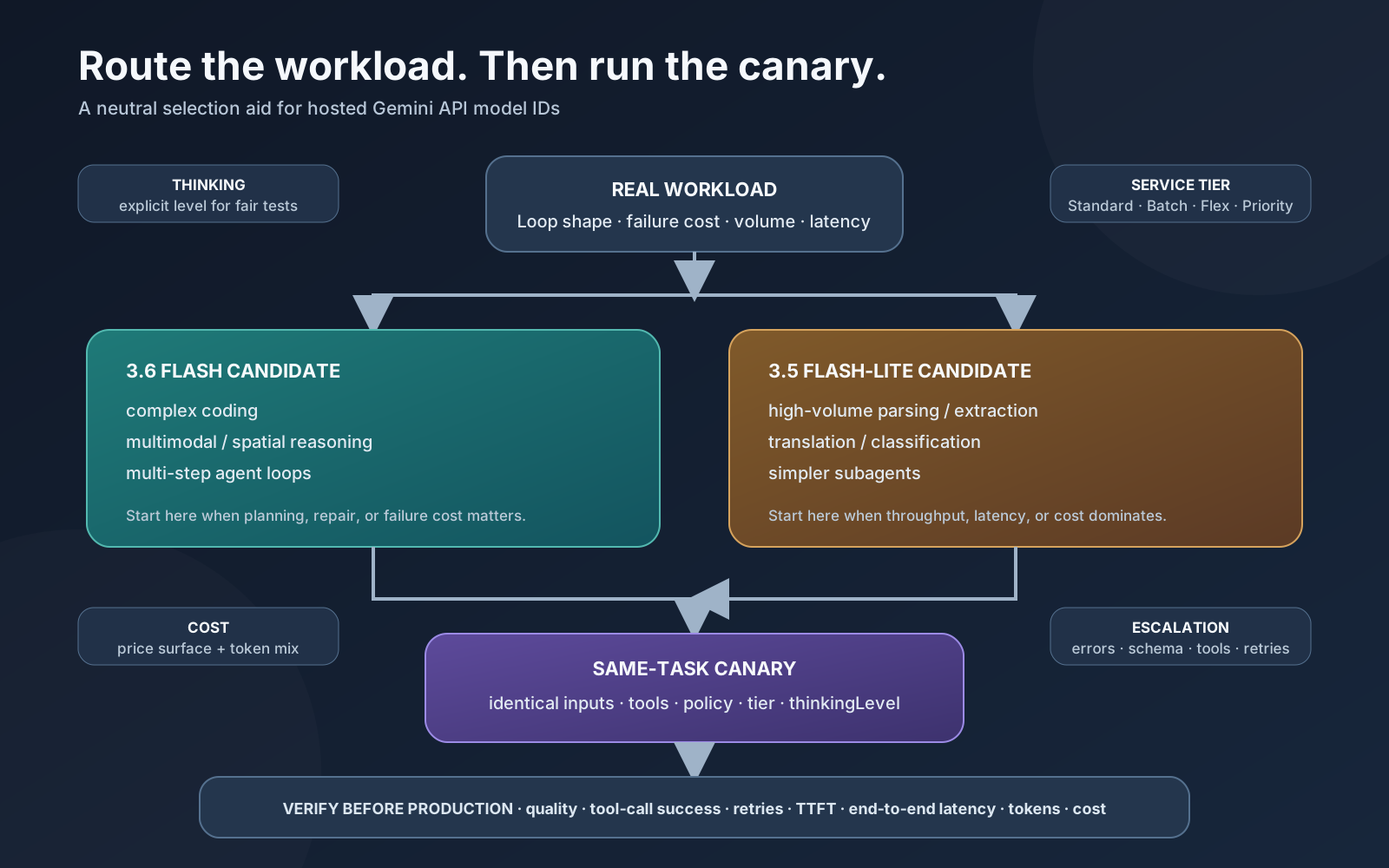
My starting hypothesis is straightforward: put 3.6 Flash into the canary for complex coding, multimodal/spatial reasoning, and multi-step agent loops. Put 3.5 Flash-Lite into the canary for high-throughput, low-latency, low-cost parsing, translation, classification, structured extraction, and simpler subagents. That is an editorial inference from Google’s positioning, not an independent test and not a claim that 3.6 always wins.
If you need a quick answer, pick one real task and test both exact model IDs. The useful next action is to record quality and operating data, not to turn a leaderboard score into a production reliability claim.
Capability and control-plane matrix
The documented capabilities below are scoped to the Gemini API model pages. A listed capability does not prove that every downstream product, enterprise surface, or tool workflow will expose or successfully use it.
| Dimension | gemini-3.6-flash | gemini-3.5-flash-lite | How to read it |
|---|---|---|---|
| Status | Stable; described as GA by Google | Stable; described as GA by Google | Current status; maintain it |
| Release date | 2026-07-21 | 2026-07-21 | Separate from this article’s 2026-07-24 source date |
| API input/output | text, image, video, audio, PDF input; text output | text, image, video, audio, PDF input; text output | PDF is scoped to the Gemini API model pages |
| Context/output limits | 1,048,576 input tokens / 65,536 output tokens | 1,048,576 input tokens / 65,536 output tokens | Limits do not guarantee equal latency |
| Thinking | minimal, low, medium, high; default medium | minimal, low, medium, high; default minimal | minimal is not guaranteed thinking-off |
| Tools listed on the API pages | caching, code execution, computer use (Preview), file search, function calling, Google Maps grounding, Search grounding, structured outputs, thinking, URL context | Same list | Listed support is not workflow success |
| Consumption options | Batch, Flex, Priority, plus the Standard price surface | Batch, Flex, Priority, plus the Standard price surface | Tier changes cost and waiting behavior |
| Google’s positioning | coding, knowledge work, multimodal performance, agentic execution, spatial reasoning, and rapid loops through complex coding cycles | high-throughput, low-latency, low-cost execution; parsing, translation/classification, structured extraction, and simpler data processing | Vendor statements, not workflow guarantees |
Google’s model card reports a useful but bounded comparison: on its task and harness definitions, 3.6 Flash versus 3.5 Flash scores 49% versus 37% on DeepSWE, 63.9% versus 49.7% on MLE-Bench, 83.0% versus 78.4% on OSWorld-Verified, 1421 versus 1349 on GDPval-AA v2, and 91.8% versus 77.3% on GDM-MRCR v2 at 128k average. These are Google’s model-card benchmark results as of July 2026, not application reliability or an SLA.
The Lite model card reports 3.5 Flash-Lite versus 3.1 Flash-Lite at 54.2% versus 38.3% on SWE-Bench Pro, 54.0% versus 31.0% on Terminal-Bench 2.1, 74.0% versus 54.3% on OSWorld-Verified, and 72.2% versus 60.1% on GDM-MRCR v2 at 128k average. That is not a direct 3.6 Flash versus Lite comparison, so treat it as context about Lite versus its prior Lite generation rather than a routing verdict.
Google’s launch post also says 3.6 Flash used 17% fewer output tokens than 3.5 Flash on the Artificial Analysis Index and used fewer reasoning steps/tool calls in multi-step workflows. Attribute this to Google and the named external index; do not infer a universal cost reduction.
If your evaluation target can read files, call tools, edit code, or advance an agent loop, the work-agent evaluation checklist for permissions, review, and real task testing is a useful companion. Scores can narrow the candidates; they cannot verify whether actions are safe or results reviewable.
Pricing and service tiers: separate $7.50 from $9.00
The table below uses the Gemini Developer API paid-tier price surface, per 1M tokens. Keep the model name beside every input and output price. Output prices include thinking tokens.
| Gemini Developer API paid tier | gemini-3.6-flash input / output | gemini-3.5-flash-lite input / output | Service meaning |
|---|---|---|---|
| Standard | $1.50 / $7.50 | $0.30 / $2.50 | Synchronous; full price |
| Batch | $0.75 / $3.75 | $0.15 / $1.25 | Asynchronous; 50% of Standard; target turnaround up to 24 hours |
| Flex | $0.75 / $3.75 | $0.15 / $1.25 | Synchronous; 50% of Standard; best-effort/sheddable; target 1–15 minutes |
| Priority | $2.70 / $13.50 | $0.54 / $4.50 | Low-latency, non-sheddable; 75–100% over Standard |
Pricing correction
The Standard output price for gemini-3.6-flash is $7.50/1M. The adjacent $9.00/1M row belongs to gemini-3.5-flash, not gemini-3.6-flash and not gemini-3.5-flash-lite. Lite’s Standard output price is $2.50/1M. The 3.6 model card also places 3.6 Flash at $7.50 and 3.5 Flash at $9.00, which corroborates a neighboring-model mix-up rather than a target-model price conflict.
Batch is cheaper, but asynchronous; it is not a faster interactive route. Flex is synchronous but best-effort/sheddable. Priority is a service-tier choice, not a different model. These are service-tier characteristics from Gemini API optimization documentation, not per-account, region, input-size, or concurrency speed benchmarks, and not an SLA.
Google Cloud Agent Platform has a separate pricing surface. Its Flex/Batch table lists 3.6 Flash at $0.75 input / $3.75 output and 3.5 Flash-Lite at $0.15 input / $1.25 output, with endpoint and long-context rules. Do not combine those figures with Gemini Developer API Standard or Priority prices.
Routing tree: look at loop shape, failure cost, and volume
This is an editorial starting tree, not a final answer:
Real workload
├─ Complex coding, spatial/multimodal reasoning, multi-round tools and repair?
│  └─ Start the canary with gemini-3.6-flash
├─ High-volume parsing, translation/classification, structured extraction, simple subagent?
│  └─ Start the canary with gemini-3.5-flash-lite
└─ Hard to classify?
   └─ Run both models on the same bounded canary
          ↓
same-task canary → quality, tools, retries, latency, tokens, cost gates → primary/fallbackgemini-3.6-flash: suitable / not suitable
Suitable as a candidate: complex coding cycles, agent loops that need multi-step planning and tool calls, multimodal tasks involving image/video/audio/PDF, spatial reasoning, or work where failure cost justifies testing stronger reasoning first. These directions come from Google’s positioning; they do not replace your acceptance criteria.
Not safe to assume: that it is always faster, cheaper, or successful with tools, or that benchmarks predict your code edits, customer-data processing, or production actions. Its higher Gemini Developer API Standard price also means a default to 3.6 can add cost when the workload does not need those capabilities.
gemini-3.5-flash-lite: suitable / not suitable
Suitable as a candidate: high-volume, repetitive, well-structured parsing, translation/classification, schema-defined extraction, and simpler subagent work. Google positions Lite for high-throughput, low-latency, low-cost execution and says it has lower latency than 3.6 Flash on high-volume tasks; measure that with your request size, concurrency, and service tier.
Not safe to assume: that every complex agent loop, code edit, or long tool chain can be replaced with Lite. If the canary shows unacceptable semantic error, invalid structured output, repeated tool-call failure, or excessive retries, escalate to 3.6 rather than treating low price as success.
Latency, 350 output tokens/s, and deployment boundaries
Google’s launch announcement attributes 350 output tokens/s to Artificial Analysis and says 3.5 Flash-Lite has lower latency than 3.6 Flash for high-volume tasks. The allowed official sources do not say whether 350 is decode speed or end-to-end throughput, a median or percentile, streamed or non-streamed, or which input/output size, concurrency, region, endpoint, tier, thinking level, streaming mode, or load produced it. Treat it as attributed context, not a universal rate or SLA.
For your own measurement, streaming exposes incremental output events. Completed API responses expose input, cached, output, tool-use, and thought-token usage. Long-context documentation also says larger queries generally increase time to first token. Use these definitions:
- TTFT: request-send to the first streamed model-output event.
- generation output tok/s: visible output tokens divided by the active generation interval.
- end-to-end tok/s: visible output tokens divided by request-to-completion wall time.
Report tier, thinking level, input size, concurrency, region, streaming, retries, and tool calls beside every result. That keeps a vendor-attributed benchmark rate separate from your production latency.
The access surfaces are also not interchangeable. Google’s launch announcement says both models can be used through the Gemini API, Google AI Studio, and Android Studio; 3.6 Flash is additionally in Google Antigravity. Both are in the Gemini app, while Lite is also rolling out in Google Search. For enterprises, both are available in the Gemini Enterprise Agent Platform, while 3.6 Flash is additionally in the Gemini Enterprise app. The DeepMind distribution lists differ too: 3.6 lists the Gemini app, Gemini Enterprise app, Gemini Enterprise Agent Platform, Google AI Studio, Gemini API, and Google Antigravity; Lite lists the Gemini app, Google AI Studio, Gemini Enterprise Agent Platform, and Gemini API.
This is not a universal-availability list. “Rolling out” does not mean every region or account can select the model. There is also a specific conflict: the launch announcement groups both models under Android Studio, while the Lite model card omits Android Studio. Treat Android Studio access for Lite as an announcement-level claim that needs a current surface-specific check. For a broader distinction between hosted access, API integration, and self-hosting responsibility, see Kimi K3’s access and deployment boundaries.
Keep PDF scoped to the API: it is an input capability listed by the Gemini API model pages, not a promise that every downstream surface exposes PDF. If you care about local runtime, data control, and execution boundaries, do not confuse hosted API capability with local operation; the Gemma 4 12B local agent laptop guide is a useful counterpoint, while this comparison does not recommend local weights or self-hosting.
Lifecycle is surface-specific as well. Google Cloud lifecycle documentation lists 3.5 Flash-Lite as available at least 12 months after release, with retirement on July 21, 2027 or later. It lists 3.6 Flash under shorter-term availability: no retirement date announced, but short-term models retire 45 days after a replacement is released. This is Gemini Enterprise Agent Platform scope, not a Gemini Developer API deprecation guarantee. Both model cards warn about ordinary foundation-model limitations, including hallucinations and occasional slowness or timeout issues; that is not a reliability score.
Same-task canary: choose a primary and fallback
This is the most important operational step. The protocol below is a proposed reproducibility method, not a reported live result.
Canary checklist
- Choose a bounded task set covering the real happy path, one boundary input, and one case with meaningful failure cost.
- Hold the prompt, input files, tool definitions, safety policy, and output schema identical for both exact IDs.
- Hold the service tier constant and set the same explicit
thinkingLevel; do not let 3.6’smediumdefault and Lite’sminimaldefault silently change the experiment. - Record correctness, semantic error, schema validity, tool-call success, retries, and human review results.
- Record TTFT, end-to-end wall time, generation output tok/s, and input, cached, output, thought, and tool-use tokens.
- Calculate cost from the dated 2026-07-24 price table; write model, tier, thinking level, input size, concurrency, region, and streaming settings beside the result.
- Give code edits, external actions, and structured extraction separate acceptance criteria; do not hide different risks inside one score.
When to escalate, and when to keep Lite
Escalate to 3.6 Flash if Lite exceeds your task-specific threshold for semantic errors, invalid structured output, tool-call failures, or retries. The threshold must belong to the workflow: model capability is not workflow reliability.
Conversely, make Lite a fallback or high-throughput primary only after it passes the same quality, schema, tool, and retry gates. A practical route might default complex coding loops to 3.6, then move repeatable, lower-risk sub-tasks to Lite; if Lite stays within the real error budget, keep it for cost-sensitive routing. This article reports no live canary result.
Maintenance note: fields that expire first
The source date for this article is 2026-07-24, and the release date is 2026-07-21. Before reusing the matrix, recheck model ID and status, API/AI Studio/enterprise surfaces, thinking and tool support, context/output limits, pricing, data-use terms, regional access, and deprecation/lifecycle policy. Run a source-date audit at least quarterly, and rerun the same-task canary after a material SDK, endpoint, service-tier, or model-version change.
FAQ
Is there a universal winner?
No. 3.6 Flash is the starting candidate for complex coding, multimodal/spatial reasoning, and multi-step agent loops. Lite is the starting candidate for high-volume parsing, translation/classification, structured extraction, and simpler subagents. Both routes need the same canary.
Does minimal mean thinking-off?
No. The thinking documentation says minimal is not guaranteed to disable reasoning, and complex prompts may still reason. Set thinkingLevel explicitly for a fair comparison.
Why does $9.00 appear in some tables?
It is the neighboring gemini-3.5-flash Standard output row. The current Gemini Developer API Standard output prices for the target models are $7.50/1M for gemini-3.6-flash and $2.50/1M for gemini-3.5-flash-lite.
Can I use 350 output tokens/s for capacity planning?
Not directly. It is a Google-attributed Artificial Analysis figure with unknown definition, percentile, request settings, region, and load. Measure TTFT, generation output tok/s, end-to-end tok/s, and the full operating conditions yourself.
Are Gemini API, AI Studio, Android Studio, Antigravity, and Enterprise the same thing?
No. They are different surfaces, and the announcement, model cards, API model pages, and Agent Platform documentation do not list exactly the same access. Keep PDF scoped to the API model pages, check Lite’s Android Studio access currently, and remember that rollout does not mean universal access.
How do I set a primary and fallback?
Fix all inputs, tools, policy, tier, and thinkingLevel for the same bounded task set, then record quality and operations data. Let task-specific gates decide: Lite becomes a fallback only after meeting the same acceptance criteria; high-risk failures should escalate to 3.6.
When should I rerun the canary?
Rerun after changes to model, surface, tool or thinking support, context/output limits, pricing, data-use terms, regional access, or lifecycle. Rerun after a material SDK, endpoint, service-tier, or model-version change, and audit source dates at least quarterly.
Image and source note
The cover is an original Wesbase workload-to-model decision tree. It uses no Google, Gemini, Artificial Analysis, or media logos and no copied external image. This article stays within the allowed official sources and explicitly separates fact, vendor statement, inference, and unknown; prices, surfaces, tools, and benchmarks retain their source and date boundaries.