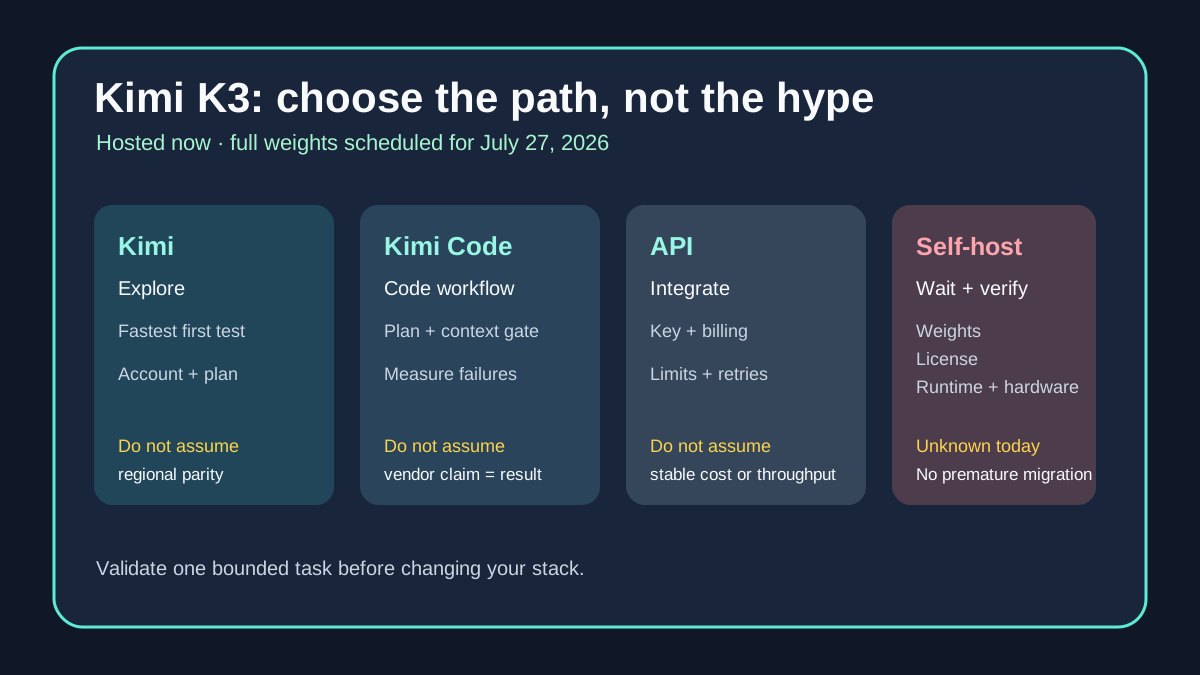
Start with the decision: do you want to try the model or operate it?
Kimi K3 was released on July 16, 2026. Kimi’s official help center lists Kimi App, kimi.com, Kimi Work, Kimi Code, and the Kimi API as access paths. The same page lists July 27 for the full weights.
That means the useful question is not simply “Is it open?” The question is whether you want to explore a capability, connect a service, or take responsibility for serving a model yourself. Those are different cost and risk decisions.
What has the company confirmed?
Kimi Code’s release notes describe K3 as a 2.8-trillion-parameter model with native vision and up to a 1M-token context window, already integrated into Kimi Code. These are vendor capability descriptions, not independent benchmark or local-performance guarantees.
The same notes say Moderato and above can call K3, while Allegretto and above unlock the 1M context window. If you use Kimi Code, check the current plan rather than assuming that the model name means identical access for everyone.
Moonshot’s official site exposes Kimi, the API, desktop apps, and the consumer app. The API documentation requires an API key. Its limits page also documents recharge-based tiers and warns that limits can be adjusted temporarily when cluster load is high.
A decision matrix
| Your goal | Start with | What you take on | Do not assume |
|---|---|---|---|
| Explore long tasks, vision, or knowledge work | Kimi / kimi.com | account, plan, and service availability | every region or account has the same rollout |
| Try it inside a coding workflow | Kimi Code | plan entitlements, context access, and quotas | a vendor capability statement equals project success |
| Connect it to your own software | Kimi API | API key, billing, rate limits, retries, and budgets | price and throughput are permanent |
| Need data control and predictable long-term cost | evaluate self-hosting after weights | license, hardware, runtime, serving, and measurement | 2.8T parameters imply a personal-computer deployment |
Why “open” does not mean “ready to self-host today”
At the time of this review, official pages confirm a planned full-weight date, but the sources reviewed here do not yet provide the complete download address, license text, recommended hardware, quantized variants, or inference runtime. Without those details, you cannot infer VRAM, throughput, or electricity cost from parameter count, and community numbers should not become a deployment guide.
After July 27, check five things in order: whether the weights are actually downloadable; whether the license fits your use; whether quantization and an inference runtime exist; whether the hardware runs at an acceptable speed; and whether measured total cost beats the hosted or API path. If one is missing, do not put self-hosting into a production architecture yet.
Who should use it, and who should wait?
If you need to know whether K3 handles a specific task, start with a hosted path. Use a fixed repository, document job, or image and record output quality, completion time, failures, and cost. That is more useful for your decision than a generic leaderboard position.
If you need software integration, the API is the direct route, but design for rate limits, key protection, retries, and a budget ceiling. A new model name is not a reason to connect an unsupervised agent directly to production.
For a comparison of API routing, cost, latency, and deployment responsibility, see the Gemini 3.6 Flash vs. 3.5 Flash-Lite model selection guide.
If you do not have multi-GPU infrastructure, model-serving experience, or a clear data-control requirement, you do not need to chase the weights immediately. The Gemma 4 local AI workflow guide is a useful reminder that model capability and stable device capability are different questions.
A low-risk verification flow
- Pick one repeatable task instead of testing the whole production system.
- Fix the input, context length, and output requirements.
- Test quality and failure modes in Kimi or Kimi Code.
- If you use the API, record tokens, latency, rate limits, retries, and cost.
- After the weights arrive, check the license, runtime, and hardware before comparing the same task with the hosted result.
For a broader example of reproducible workflow testing, see the UI Skill hands-on guide. The goal is not to prove that K3 is universally stronger; it is to make your own choice traceable.
What to watch after July 27
First check whether the weights and technical report arrive as planned. Then check the license, quantization, runtime, and hardware documentation. Only after that should you measure throughput, latency, quality, and total cost on your own task.
The defensible conclusion today is simple: K3 is ready to try as a hosted model, coding tool, and controlled API integration. Self-hosting remains a project to evaluate after the weights and engineering documentation are available.
FAQ
Can I self-host Kimi K3 today?
As of July 20, 2026, the official page lists July 27 for the full weights. Download, license, hardware, and runtime details still need official confirmation.
What is the safest way to try Kimi K3 now?
Start with Kimi or Kimi Code for exploration, and use the API for software integration. Validate one bounded task at a time.
Does every Kimi Code plan include the same K3 access?
The official release note lists Moderato and above for K3, and Allegretto and above for 1M context. Check the current account page.
Should I deploy the weights immediately on July 27?
Not by default. Check weights, license, quantization, runtime, hardware, and measured cost before migrating.