The Important Part Is the Workbench, Not a New Model
Anthropic’s Claude Science announcement is easy to misread as another model launch. It is not. The useful signal is that Claude Science is a beta workbench for scientists, built around existing Claude models.
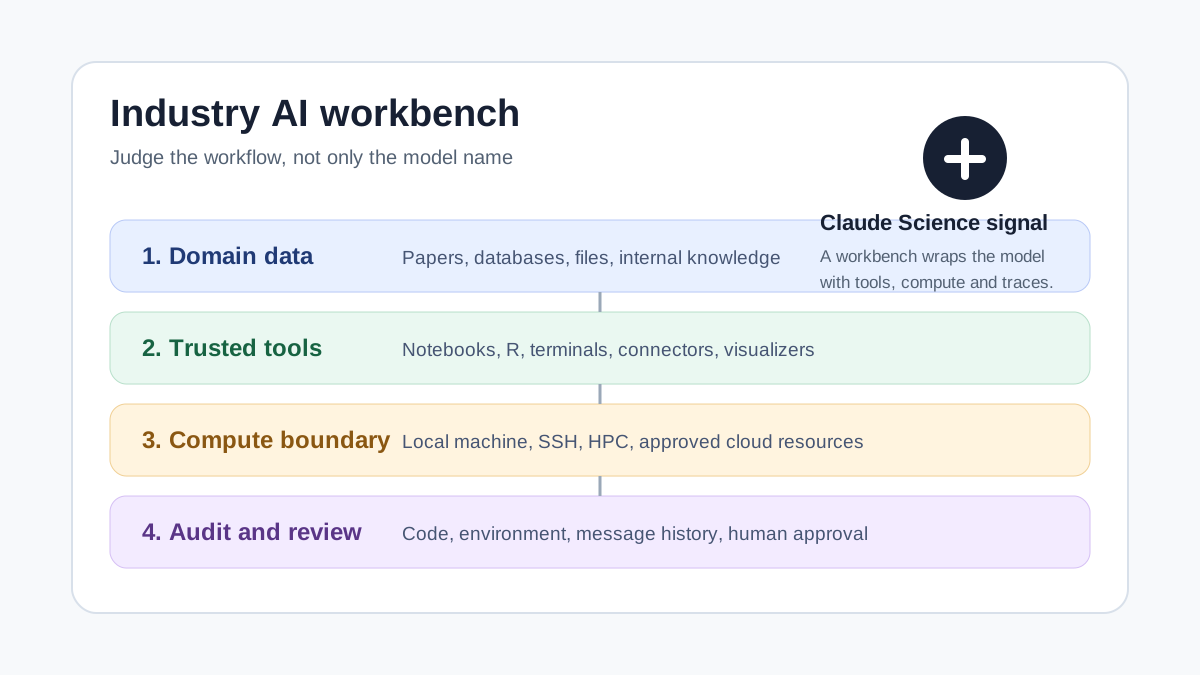
That marks a bigger product shift. Frontier AI companies are moving from “ask a model a question” toward “put a model inside a real domain workflow.” For scientific teams, that means literature search, databases, notebooks, R, terminal jobs, HPC clusters, figures, manuscripts and audit trails need to live closer together.
Even if you are not a scientist, this matters. The same pattern already appears in Claude Code, enterprise search, legal tools, data-analysis products and customer-support systems. The AI company is no longer selling only a chat box. It is selling software for how a particular kind of work gets done.
What Is Confirmed
Anthropic announced Claude Science on June 30, 2026. Its official description is an AI workbench that integrates common scientific tools and packages, produces auditable artifacts and provides flexible access to compute.
The announcement says Claude Science can run on macOS, Linux, remote machines and HPC login nodes. It can connect to scientific workflows involving tools such as PubMed, Jupyter, R and terminals. It includes curated skills and connectors for genomics, single-cell work, proteomics, structural biology, cheminformatics and related areas.
The auditability claim is central. Anthropic says outputs can include code, environment information, message history and plain-language explanations so researchers can validate and reproduce results. The product is in beta for Claude Pro, Max, Team and Enterprise users. Anthropic is also supporting up to 50 AI-for-science projects with up to $30,000 in credits, with applications open through July 15, 2026.
TechCrunch and TechRadar both framed the product as a workflow or workbench move, not a new-model story. The Verge reported a broader Anthropic ambition around drug discovery, but that should be separated from the already confirmed product launch because many details remain public unknowns.
Why This Is Happening Now
Many AI pilots hit the same ceiling: the model can answer questions, but the answer does not reliably enter the team’s production workflow.
Science makes that ceiling obvious. A research problem may involve papers, preprints, experimental data, Python notebooks, R scripts, HPC queues, 3D structures, figures, manuscripts and citation checks. A plain chat interface can explain one script or draft one paragraph. It does not automatically become a reproducible research environment.
Claude Science is aimed at that gap. The pitch is not “the model is smarter, so science becomes automatic.” The pitch is “the model sits where researchers already work, uses the tools they already trust, and leaves traces they can review.”
That is the same reason the launch is relevant to enterprise AI. Many companies have tried AI demos that never became durable systems. They can write a summary but cannot handle permissions. They can generate code but cannot enter deployment. They can make a chart but cannot explain the data lineage. They can draft a report but cannot be audited.
Five Layers of an Industry AI Workbench
When you evaluate tools like this, do not start with the model name. Start with the stack.
| Layer | Question to ask | Claude Science signal |
|---|---|---|
| Domain data | Can it reach real databases, papers, files and internal material? | It targets scientific databases, literature and experiment workflows |
| Toolchain | Can it use the tools practitioners already use? | Jupyter, R, terminals, scientific visualization and specialized connectors |
| Compute | Can it run near existing machines or clusters? | Local machines, SSH, HPC login nodes and on-demand compute |
| Auditability | Can results be traced to code, environment and history? | Outputs include code, environment details, explanations and message history |
| Human review | Can errors, citations, numbers and figures be checked? | Reviewer agents inspect citations, calculations and figure consistency |
These layers are closer to the buying decision than the model name. Models can change. A workbench that connects to a team’s tools, permissions, data and review process becomes part of the operating layer.
Who Is Affected
For scientists, the immediate change is that AI is moving from “help me understand this code” to “help me run a traceable analysis.” That can save time, but it also raises the review burden. The closer the work gets to papers, experiments, patients or regulated claims, the less acceptable it is to treat AI output as final.
For developers and data teams, Claude Science is a signal that vertical AI products will look more like agent environments with tool access. Code review, data analysis, report generation and customer deliverables may all require the same primitives: call tools, keep logs, reproduce results and wait for human approval before high-risk steps.
For enterprise buyers, the questions change. “Which model does it use?” and “How long is the context window?” are not enough. Buyers also need to ask where data stays, who can access it, how results are reproduced, how failures are traced, and whether admins can enable, disable or scope the product.
For ordinary AI-tool users, the lesson is simple: do not chase only a stronger model. A better workflow often comes from defining where inputs come from, which tools are allowed, how outputs are saved, who reviews them and what happens when the system fails.
Do Not Confuse a Workbench With an Autonomous Scientist
Claude Science also creates a temptation to overstate the story as “AI will discover drugs by itself.” That claim needs restraint.
The Verge reported that Anthropic has broader drug-discovery ambitions and that AI already touches many parts of pharmaceutical R&D. The same reporting also makes the limits clear: real candidates still need lab work, toxicity and efficacy tests, clinical trials, manufacturing plans and regulatory approval.
So the grounded reading is this: Claude Science is a confirmed industry-workbench product. Anthropic’s drug-development ambition is a longer-term claim that needs more public detail and years of evidence.
A Practical Evaluation Checklist
Use this checklist for Claude Science or any vertical AI workbench:
| Question | Why it matters |
|---|---|
| Is it a new model or an existing model inside a workflow? | Prevents model-launch hype from hiding the product shape |
| Which real tools and data sources does it connect to? | Determines whether it fits daily work |
| Does sensitive data need to leave existing systems? | Shapes privacy, compliance and adoption |
| Are results tied to code, sources, environment and history? | Determines reproducibility and audit value |
| Can humans approve high-risk actions? | Decides whether it is production-safe |
| Can failures be traced to a specific step? | Determines support and maintenance cost |
| Does it handle long tasks or only demos? | Separates workflow value from presentation value |
| How hard is it to migrate away? | Reveals lock-in risk |
The same checklist works for coding agents, legal AI, customer-support AI, data-analysis agents and enterprise search products.
What to Watch Next
Three signals matter now.
First, watch whether beta users publish reproducible examples rather than only testimonials. A strong case study should show inputs, tools, compute steps, review, failure handling and what humans changed.
Second, watch how institutions handle sensitive data. “Runs on your infrastructure” is a promising claim, but real adoption depends on permissions, logging, admin controls and data retention.
Third, watch whether competitors converge on the same vertical-workbench pattern. OpenAI, Google, AWS, specialist scientific software companies and open-source toolchains all have plausible positions. The winner may not be the company with the strongest model headline. It may be the company that fits the workflow best.
Claude Science does not prove that AI can do science alone. It does show where AI products are going: from model providers toward industry work environments. The practical lesson is to judge AI tools by whether they can enter the real steps of your work and leave evidence you can check.