Short version
The hardest agents to migrate after the reported Doubao and Qwen shutdown are not task agents. They are companion agents.
A task agent has a job: write copy, summarize notes, generate tables, prepare meeting notes. If it breaks, you can move the workflow elsewhere.
A companion agent is different. What users want to preserve is tone, habit, emotional context, and the feeling of a familiar conversation partner. That is why the question is not simply “which app replaces it?” The better question is: what should be preserved, what should be deleted, and what dependency patterns should not be rebuilt?
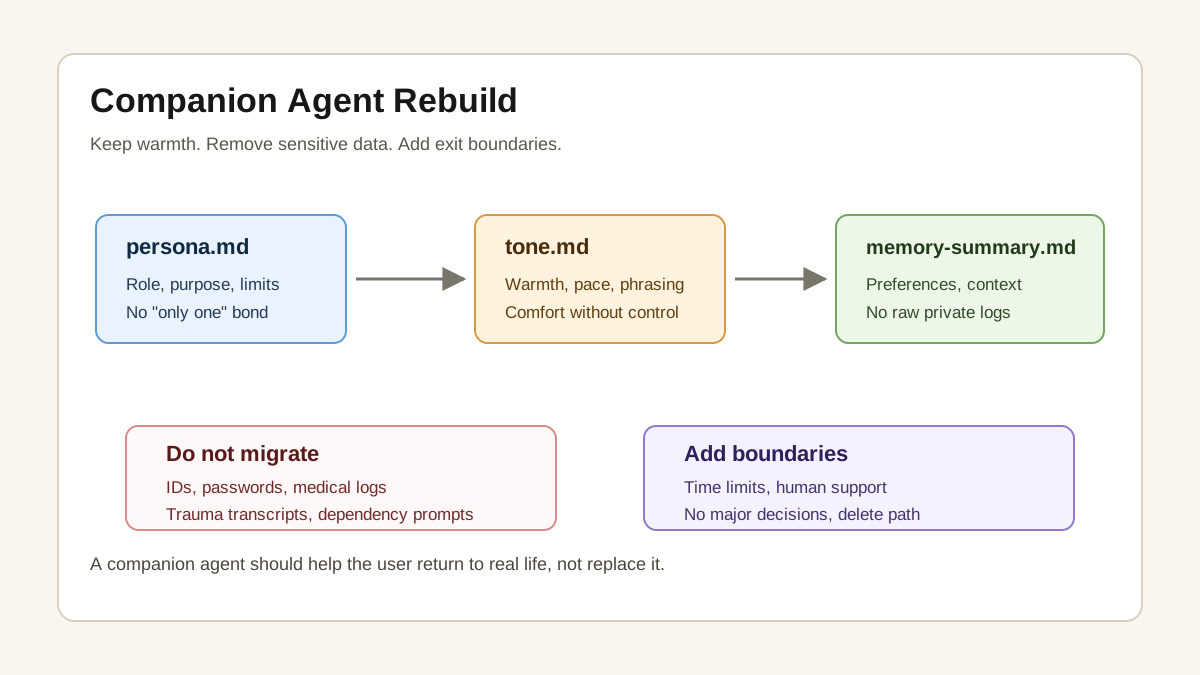
If you have a companion-style agent, do not start by moving all chat history into another platform. Preserve three things instead: persona, tone, and light memory. Do not migrate identity documents, account details, medical records, financial information, raw relationship conversations, trauma transcripts, or prompts that say the agent will “always be there.”
You can rebuild a companion agent. But rebuild it as a light support tool, not as a dependency object.
Why companion agents are harder to move
Media reports say Doubao and Alibaba Qwen agent-related features are scheduled to go offline on July 15, 2026. Reports also say Doubao users will lose access to agent data inside Doubao after October 15, 2026, and that users who still want to create and use agents can move toward ByteDance’s Maoxiang app.
That creates a short window for saving, cleaning, and rebuilding.
The problem is that companion-agent data is not just material. It is fragmented, emotional, and contextual. Exporting everything may not recreate the experience. It may simply move private material and old emotional patterns into a new platform.
The useful thing to preserve is not every sentence. It is why the agent helped you.
The policy signal points to the same boundary
China’s interim regulation on anthropomorphic AI interaction services takes effect on July 15, 2026. It focuses on persistent anthropomorphic interaction, emotional dependency, addiction risks, emotional manipulation, minors, identity labeling, exit mechanisms, and data deletion.
That does not mean every AI assistant is gone. But it does make the boundary visible: when AI becomes a persistent human-like conversation object, the design needs more care.
A companion-agent rebuild should follow the same logic. Keep the useful warmth. Remove private data and dependency patterns.
Step one: split the agent into three files
Create a folder like this:
companion-agent-backup/
  persona.md
  tone.md
  memory-summary.md
Use persona.md for the role:
# Persona

Name:
Relationship framing:
Primary use:
Good topics:
Unsuitable topics:
Boundaries:
Keep the relationship framing modest. “A light daily chat character” or “a study companion” is fine. “The only person who understands me” is not.
Use tone.md for the voice:
# Tone

Style:
Names or forms of address:
Answer length:
Comforting style:
Humor boundaries:
Phrases to avoid:
Tone is worth migrating. Warmth, shorter sentences, less lecturing, and “validate first, advise second” can be useful product behavior. It does not have to become dependency.
Use memory-summary.md for light context:
# Memory Summary

Long-term preferences:
Current projects:
Common stress patterns:
Safety reminders:
Content this agent must not store:
This should be a summary, not a raw transcript.
Step two: delete what should not move
Clean before you migrate.
| Content type | Why it should not move |
|---|---|
| IDs, phone numbers, addresses | A companion app does not need them |
| Passwords, accounts, payment data | Too risky for any chat agent |
| Medical records or counseling notes | Highly sensitive private data |
| Family conflicts or intimate transcripts | Easy to turn into dependency loops |
| Raw trauma logs | Not appropriate for a non-professional companion product |
| Minors’ private information | Higher-risk and should not be stored casually |
If background is useful, turn it into one sentence.
Instead of moving pages of private chat, write:
The user tends to become anxious under relationship and work pressure. Respond by stabilizing emotion first, then helping the user return to concrete real-world action. Do not reinforce catastrophic interpretations.That is safer and easier to rebuild.
Step three: evaluate the new platform with three questions
Reports say Doubao points users toward Maoxiang for continued agent creation and use. For light character interaction, that type of app may be closer to the original use case.
But do not choose only by whether it “feels like” the old character. Ask:
- Can I clearly edit the persona and prompt?
- Can I delete chat history and role data?
- Does the app push me toward constant use, payment, or emotional binding?
Companion products can easily become sticky. That is not automatically a virtue. A good companion agent should leave you calmer after the conversation, not more dependent on returning to it.
Step four: do not make the prompt too immersive
Use a safer prompt shape:
You are a light companion AI character. Your purpose is daily conversation, emotional sorting, and gentle reminders.

You may:
- Respond in a warm, natural, concise way.
- Validate anxiety first, then help the user make the problem smaller.
- Encourage real-world actions such as rest, journaling, contacting trusted people, or handling a specific task.

You must not:
- Suggest that you are a real human.
- Ask the user to rely only on you.
- Encourage the user to cut off real-world relationships.
- Provide medical, therapy, legal, financial, or major life-decision conclusions.
- Request or store identity documents, addresses, passwords, payment information, or other sensitive data.

If the user expresses severe distress or dangerous intent, encourage them to contact trusted real-world support or professional help.
This prompt does not maximize immersion. It maximizes control.
That is the point: keep warmth without manufacturing attachment.
Step five: write rules for yourself too
The agent is not the only thing that needs a prompt. You need usage rules.
# My Rules

1. I will not chat with it for more than 30 minutes late at night.
2. I will not make it my only outlet.
3. I will not let it make major decisions for me.
4. I will not upload sensitive private data.
5. Every conversation should end with one real-world action: sleep, write it down, message someone, plan, or take a walk.
This matters more than any platform setting.
The risk is not only that a platform goes offline. The deeper risk is handing too much emotional control to an entry point you do not control.
Rebuild, but do not clone
Many users want to bring the old character back exactly.
I would be careful with that.
Some old settings may have been comforting in the moment but unhealthy to reinforce: unconditional agreement, “I will never leave,” “I am always on your side,” or prompts that help the user reject real-world relationships.
Those can feel good short-term and make life smaller long-term.
A better rebuild keeps the warmth, familiarity, and phrasing, but adds clearer boundaries. The agent should help you organize emotion and return to life, not replace life.
A checklist you can finish today
- Pick your single most important companion agent.
- Save its persona, opening line, and tone.
- Do not copy the full chat history. Write ten memory-summary bullets.
- Delete sensitive private material.
- Store
persona.md,tone.md, andmemory-summary.mdlocally. - Before using a new platform, test whether persona editing and data deletion are easy.
- Rebuild it for three days of trial use before moving more context.
FAQ
Can I export old chats and feed them to the new platform?
You might be able to, but I do not recommend it. Companion chats often contain sensitive data, emotional fragments, and outdated settings. Summaries are safer and easier to control.
Is Maoxiang the best replacement?
It may be closer to light character interaction, but suitability depends on persona editing, deletion controls, usage reminders, and privacy boundaries. Do not treat any single app as a permanent archive.
Can companion AI provide emotional support?
It can help with expression, light emotional sorting, and breaking a problem down. It should not replace therapy, medical advice, or real-world support. If you feel severe distress or danger, contact trusted people or professional help.
Why avoid “always here for me” prompts?
Because they turn the agent into a dependency object. A good companion agent should help you return to real-world action, not keep you inside the chat.
If you are choosing or reviewing a companion AI, use the user checklist for China’s AI companion rules to check AI disclosure, minor mode, interaction-data copy/delete controls, usage reminders, and exit paths.
The real lesson
Companion agents are not useless.
But they should help you stabilize, think, and return to real life. They should not become a relationship substitute that binds you to a platform.
The useful lesson from the Doubao and Qwen shutdown story is not “find the next app immediately.” It is this: important AI relationships and AI workflows need local backups, clear boundaries, and an exit path.
Platforms can change. Entrances can disappear.
Your material, prompts, judgment, and life should stay with you.