Do Not Stop at “Driverless”
Waymo said on July 8 that San Diego, Las Vegas, Tampa and Denver will soon begin fully autonomous operations without a human specialist behind the wheel. That does not mean every resident in those cities can open an app today and pay for a public robotaxi ride.
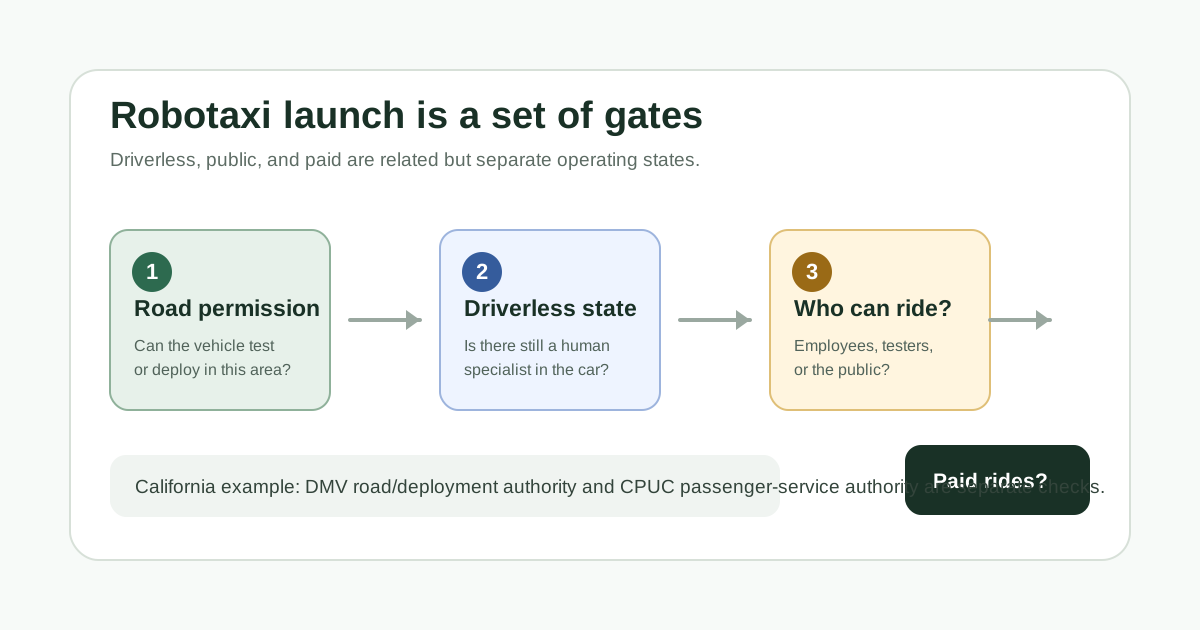
Robotaxi news often blends four different questions: whether the vehicle can operate on the road, whether a specialist is still inside, who is allowed to ride, and whether the company can charge fares. California’s Waymo Ojai case is useful because it separates those gates.
What Is Confirmed
Waymo’s official post says San Diego, Las Vegas, Tampa and Denver will soon move to fully autonomous operations without a human specialist in the vehicle. The same post says the first rider-only operations will be for employees, with public access expected later.
Waymo also said Hyundai IONIQ 5 vehicles are being driven autonomously with an autonomous specialist present. That means two tracks are moving at the same time: some cities are preparing for no-specialist operations, while another vehicle platform is still in specialist-present validation.
Ojai adds the regulatory angle. Waymo’s May post describes Ojai as a rider-first platform for fully autonomous ride-hailing and says select riders in San Francisco, Phoenix and Los Angeles would first get free rides while Waymo collected feedback.
WIRED reported on July 8 that a CPUC-related delay limits Waymo’s ability to charge for Ojai rides in California, so some Ojai rides may remain free. The point is not the free ride itself. The point is that vehicle deployment and fare authority are not the same approval.
California Has Two Important Gates
California does not regulate robotaxis with one switch.
The California DMV handles autonomous vehicle testing and deployment permissions. Its AV page describes permit categories including testing with a safety driver, driverless testing and deployment. Waymo’s DMV page shows a November 2025 update authorizing expansion into additional parts of Northern and Southern California and adding the Zeekr / Ojai model.
The CPUC focuses on passenger service. Its AV passenger service page says Driverless Pilot and Driverless Phase I Deployment participants must submit Passenger Safety Plans. It also says applicants in AV deployment programs must obtain DMV deployment permits.
Waymo Advice Letter 0004 shows how those layers connect. Waymo asked the CPUC to approve its January 2026 Passenger Safety Plan update for an expanded DMV-approved operational design domain, including San Diego, Sacramento and the Ojai vehicle platform.
So when a robotaxi headline says a vehicle has deployment approval, that does not automatically mean the company can charge the public in every new area and every vehicle configuration. For riders, that distinction matters more than the branding.
Why This Is Happening Now
Robotaxis are moving from a few core markets into broader expansion. Waymo is no longer only proving the concept in Phoenix or San Francisco. It is trying to scale across more cities, service areas and vehicle platforms.
The faster that expansion happens, the more fragmented the launch status becomes. One city may have employee-only driverless rides. Another may have limited public service. One vehicle may be in free feedback rides, while another is already part of paid service. A new platform may be technically ready but still waiting for a passenger-service or fare step.
That is why the California framework is useful. It separates “the technology can operate” from “the transportation service can be sold.” For residents, riders, automakers and city officials, the real issues are emergency response, passenger safety, incident reporting, service boundaries, fare authorization and how robotaxis fit into the local transportation system.
Who Is Affected
For riders, the biggest change is expectation management. “Fully autonomous” does not necessarily mean open public service today. Check whether access is limited to employees, invited users, Trusted Testers or the general public.
For city residents, the main question is how the vehicles interact with buses, airports, emergency services, police, schools, construction and weather events. A robotaxi is not just a car product. It is part of a city’s mobility system.
For developers and mobility teams, the important layers are service status, geofencing, vehicle platform, remote support, rider communication and exception handling. Those affect maps, payments, support, insurance, city data and third-party transportation software.
For business observers, the biggest mistake is treating “entering a city” as the same thing as “commercial revenue has started.” Commercialization requires fare authority, rider scale, fleet utilization, dispatch efficiency and unit economics.
Four Checks for the Next Robotaxi Headline
First, is the vehicle allowed to test or deploy in that area? Look for DMV or equivalent road/deployment authority, not only a company blog post.
Second, is there still a safety driver or autonomous specialist inside? Specialist-present validation, no-specialist employee operations and no-specialist public operations are different stages.
Third, who can ride? Employees, invited testers, Trusted Testers, limited public riders and all public riders carry different risk and business meaning.
Fourth, can the company charge fares? Free feedback rides, pilot service, paid passenger service and broad commercial operation are not the same thing. The Ojai situation in California shows why fare authority is its own gate.
Uncertainty and What to Watch
The public timeline for the four newly announced cities is not fixed. We still do not know exactly when public access begins, how large the service areas will be, or how quickly employee-only operations become consumer service.
Waymo’s safety data should also be read carefully. Company-reported data is useful, but it should be compared with regulatory reports, local incident records, third-party research and actual rider experience.
The next signals to watch are CPUC handling of Waymo Advice Letter 0004, the transition from employee-only to public access in cities such as San Diego, and real-world feedback from Ojai and Hyundai IONIQ 5 operations.
FAQ
Are the four new Waymo cities already open for paid public rides?
No. Waymo says fully autonomous rider-only operations in the new cities will begin with employees. Public access is expected later.
Are free Ojai rides just a promotion?
Not exactly. Waymo had already described free early rides as a feedback phase. WIRED’s latest reporting adds that the California CPUC process affects Ojai fare authority.
Does California’s rule apply everywhere in the U.S.?
No. Each state can use a different process. California is useful because it clearly separates road deployment, passenger safety planning and paid passenger service.
Should ordinary riders use robotaxis now?
That depends on your city, service area, risk tolerance and transportation alternatives. At minimum, check whether public service is open, whether fares are authorized, how emergency support works and whether your trip fits the operating area.
How is this different from ADAS or ADS in a private car?
Robotaxi service is a transportation-service problem, not only a driver-assistance feature in a consumer vehicle. For terminology, see our earlier guide: How to Read ADAS, ADS and Robotaxi Regulation.