Bottom line
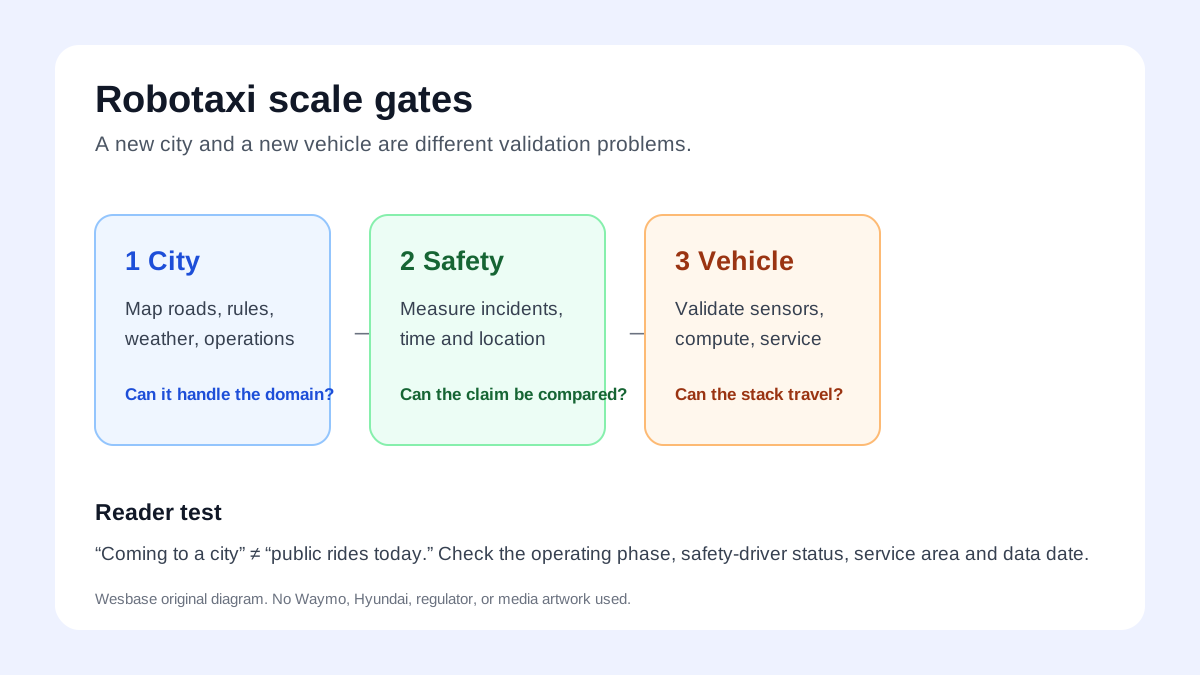
The important part of Waymo’s latest announcement is not simply “four more cities.” It separates two different scaling problems: operating in a new city and moving the same system onto a new vehicle platform.
On July 8, 2026, Waymo said it was preparing fully autonomous operations in Denver, Las Vegas, San Diego, and Tampa, with initial rider-only operations for employees and public access expected later. The same announcement said the sixth-generation Waymo Driver had begun autonomous driving on the Hyundai IONIQ 5 with an autonomous specialist present. That is vehicle validation, not public rider-only service.
What happened
The key phrase in the four-city plan is “employee-first.” A vehicle can operate without a human specialist inside while ordinary riders still cannot book it. Waymo did not provide a firm public launch date, service map, or price for these cities.
The IONIQ 5 represents a second expansion track. Waymo is not meant to run forever on one vehicle type. A new platform requires validation of sensor placement, compute, braking and steering interfaces, cabin behavior, maintenance, and safe fallback procedures. The announcement confirms that validation has started, not that the vehicle is already serving public riders without a specialist.
Why it matters now: from city permission to repeatable operations
Early robotaxi coverage often treated “entering a city” as the finish line. Once a service operates daily, the hard questions become operational: Are maps detailed enough? What happens in rain, road work, or unusual curb layouts? Can the fleet be serviced? Can remote assistance handle rare cases? Can the stack be copied onto another vehicle without creating a new safety problem?
So city expansion and vehicle expansion should be read separately:
| Signal | What it confirms | What it does not confirm |
|---|---|---|
| Employee-first rider-only plan in four cities | A new phase closer to driverless operations | When the public can book, or which streets are covered |
| IONIQ 5 autonomous validation with a specialist | The system is adapting to a new vehicle platform | When the vehicle will carry public riders without a specialist |
| Published safety data | Waymo is sharing operating data and methodology | That every city has the same risk, or the industry uses one final benchmark |
Confirmed facts, company data, and inference
Waymo’s Safety Impact page says that through March 2026 it had driven 220.6 million rider-only miles. That indicates substantial operating experience, but it remains company-published data and methodology. Readers should check the cities, period, event definitions, and comparison benchmarks instead of translating one mileage total into “equally safe everywhere.”
On July 7, Waymo also described a safety-comparison method that adjusts for location, day, and time. That matters because the risk profile of a late-night downtown trip is not the same as a daytime suburban commute. A more detailed method does not automatically make the conclusion independent; it still benefits from continuing raw-data disclosure, outside review, and comparisons across operators.
The following are editorial inferences, not commitments Waymo has made:
- Robotaxi scaling will increasingly depend on maps, fleet maintenance, remote assistance, insurance, and city operations—not only model capability.
- A multi-vehicle strategy can expand supply but also adds parts, maintenance, and safety-validation complexity.
- For a passenger, practical availability depends on reliably getting a ride from the needed origin to the needed destination, not on the company’s city count.
How to tell whether “it has arrived”
When you read the next robotaxi announcement, check:
- Operating phase: Is it manual driving, testing with a safety driver, employee rider-only, or public rider-only?
- Actual coverage: A city name is not a service map. Check neighborhoods, airports, and highways.
- Vehicle status: Is the new platform in testing, or already carrying public riders?
- Human boundary: Is anyone inside? How does remote assistance work? Who handles an exception?
- Data method: What period, location, event definition, and benchmark support the safety number?
This checklist applies beyond Waymo. It separates “announced expansion,” “preparing to launch,” “employee experience,” and “publicly available.”
FAQ
Are Waymo’s four new cities open to the public?
Not yet. Waymo says the initial rider-only operations are for employees, with public access expected later; the announcement does not provide a firm date.
Is the IONIQ 5 already carrying riders without a human?
The public announcement only confirms autonomous validation with an autonomous specialist in the vehicle. It does not establish public, rider-only service.
What does Waymo’s 220.6 million miles figure mean?
Waymo’s Safety Impact page says it had driven 220.6 million rider-only miles through March 2026. That is company-published data and methodology, not a final industry-wide safety verdict.
What should a rider check before using a robotaxi?
Check public booking access, whether a safety driver is present, the actual service area, the vehicle platform, human-support procedures, and the date and definition behind safety numbers.
Image and source notes
The cover is an original Wesbase robotaxi scaling-gates diagram. It uses no Waymo, Hyundai, regulator, or media artwork. City and vehicle updates come from Waymo’s July 8, 2026 official blog; mileage and comparison boundaries come from Waymo Safety Impact; the time-and-location methodology comes from Waymo’s July 7, 2026 research note. The article labels company facts, data interpretation, and editorial inference separately.