Bottom line
The EU’s new rules raise the safety floor for new cars, but they do not suddenly make every new car autonomous.
The European Commission says additional requirements apply to new passenger cars and vans from July 7, 2026. They include advanced emergency braking for pedestrians and cyclists, driver-distraction warnings, better forward vision, new worn-tyre tests, and an expanded safety-glass area.
For buyers, the important change is not how much “AI” a car advertises. Safety capabilities are gradually becoming a regulatory baseline. Exact behavior, trim availability, warnings, and calibration costs still depend on the manufacturer and market.
What changed
The Commission’s July 8 notice describes the update as part of the phased rollout of the General Safety Regulation. Manufacturers had more time to develop these technically demanding features, so the requirements did not all arrive on a single date.
The listed safety changes are:
| Change | What it means for drivers |
|---|---|
| Emergency braking for pedestrians and cyclists | Stronger collision-avoidance capability in defined risk scenarios |
| Driver-distraction warning | The vehicle can alert a driver when attention appears insufficient |
| Better forward vision | Vehicle design must improve the driver’s view ahead |
| Worn-tyre testing | Safety performance is tested with tyre wear in mind |
| Expanded safety-glass area | New structural requirements support occupant and pedestrian safety |
These are regulatory safety requirements, not a product launch by one autonomous-driving company. Check the official specification and type-approval information for the exact vehicle, trim, and market.
The three layers that are easy to confuse
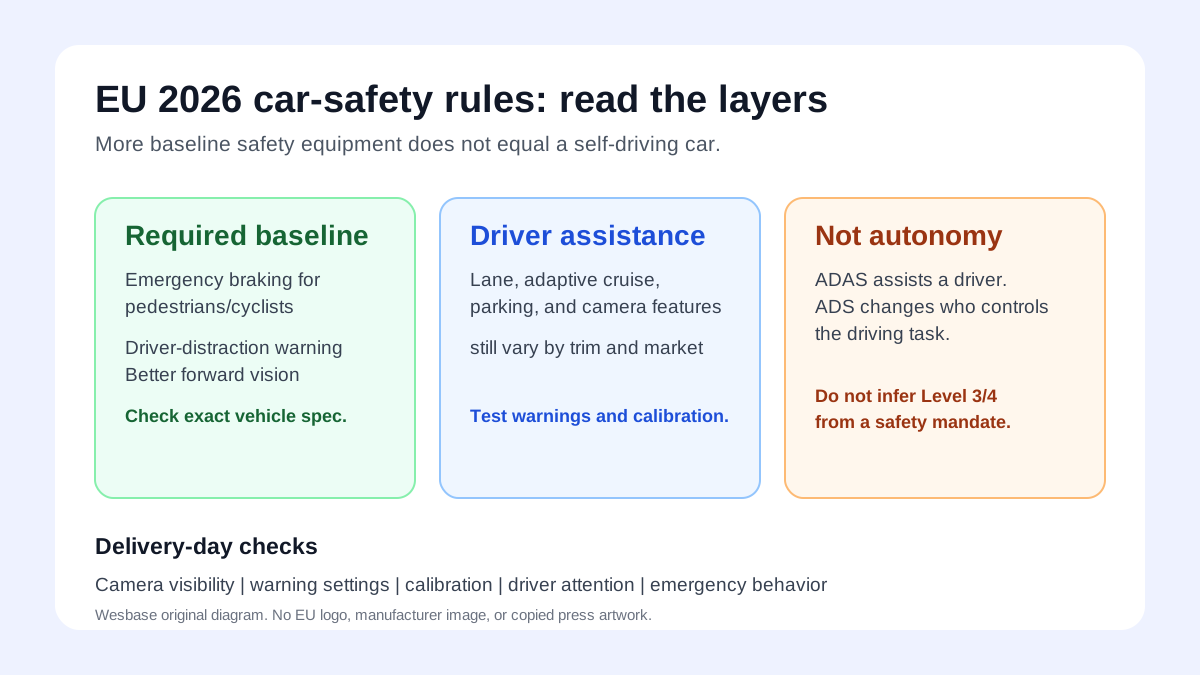
The first layer is the mandatory safety baseline. It covers functions or tests that must meet a standard, such as emergency braking, distraction warnings, and tyre performance. It answers: “What must the vehicle do at minimum?”
The second layer is ADAS, or advanced driver assistance. Lane keeping, adaptive cruise control, parking assistance, and camera features may go beyond the minimum, but they still assist a driver. The driver must understand the alerts, stay attentive, and take over when the system is unavailable or unsuitable.
The third layer is ADS or higher-level automated driving. That involves who is responsible for driving, where the system can operate without intervention, how failures are handled, and what regulators permit. Cameras, emergency braking, or “intelligent driving” branding are not proof of Level 3 or Level 4 capability.
What this changes for buyers
If you buy or register a new car in the EU, safety equipment will increasingly feel like infrastructure rather than a high-trim bonus. But do not compare feature names alone.
Ask five practical questions:
- Which trim and market actually include the function?
- Does it detect vehicles, pedestrians, cyclists, motorcycles, or road-work obstacles?
- What happens when rain, snow, dirt, or a film blocks a camera or sensor?
- Could the system’s presentation cause a driver to pay less attention?
- What will windshield, bumper, camera, radar, and wheel-alignment repairs cost after recalibration?
Regulation can raise the minimum safety level. It cannot answer these vehicle-specific questions for you. Use the manual, specification sheet, repair guidance, and independent tests.
Delivery-day checklist
First, check the cameras and sensors: their locations, cleaning requirements, and obstruction warnings. A windshield replacement, front-end impact, or wheel-alignment change can affect calibration.
Next, check driver-distraction and driver-monitoring alerts. Learn when they activate, whether warnings escalate, and which settings are adjustable. The ability to mute an alert is not permission to stop paying attention.
Then read the emergency-braking guidance. The key question is not to trigger an extreme test in a parking lot; it is to understand the speed, weather, road, and target conditions in which the system may or may not work. Follow the manufacturer’s safety instructions.
Finally, ask about repair boundaries. Confirm the calibration process after windshield, bumper, radar, camera, or tyre work, and include those costs in the ownership budget.
Confirmed facts, inference, and uncertainty
Confirmed: the Commission’s public notice gives the July 7, 2026 applicability date and lists the additional safety requirements for new passenger cars and vans.
Reasonable inference: buyers will increasingly need to compare recognition range, warning quality, calibration, and operating limits rather than simply asking whether emergency braking exists. That is a buying framework, not a test result for any particular model.
Still uncertain: how each manufacturer implements the functions, how trims vary by country, and how systems perform in rain, darkness, road works, or complex cyclist scenarios. Without independent testing or vehicle documentation, do not turn marketing language into a performance guarantee.
FAQ
Does this mean every new car is self-driving?
No. The update raises safety equipment and testing requirements. ADAS still requires driver attention; automation levels also involve responsibility, operating conditions, and regulatory approval.
Do older cars need a retrofit?
The cited Commission notice concerns new passenger cars and vans. It does not say that every older car must be retrofitted. Check the registration market, vehicle, and manufacturer notices.
Are more sensors automatically safer?
No. Sensor type, software recognition, warning design, redundancy, calibration, and driver understanding all matter. Sensor count is not proof of safety.
What should I prioritize when buying?
Check the required baseline for the target vehicle, then compare the actual trim, driver alerts, emergency-braking limits, calibration, and independent safety evidence. Do not treat an autonomy marketing term as a test result.
Image and source notes
The cover is an original Wesbase three-layer diagram. It uses no EU logo, manufacturer image, or media artwork. Rule facts come primarily from the European Commission’s public notice, with NHTSA’s consumer explanation used to distinguish ADAS from automated driving. Model-level behavior, regional specifications, and real-world performance remain items to verify.