Bottom line
The next gate for automated driving is not only whether a vehicle can navigate an ordinary road. It is whether the vehicle can recognize that an emergency scene has changed the rules—and make room for police, firefighters, and paramedics.
On July 8, 2026, NHTSA publicly asked automated-driving developers and operators to address this problem immediately. It is not a robotaxi ban, and it does not prove that every AV system has the same defect. It does move first-responder interaction from an internal engineering concern into a public deployment and trust question.
What happened
NHTSA said it had identified a clear pattern of driverless automated vehicles interfering with law enforcement and other first responders. The public notice describes vehicles entering active emergency scenes, blocking ambulance and firefighter paths, or failing to recognize and respond to flashing lights, flares, smoke, fire, and traffic cones.
The agency asked developers and operators to prioritize the issue and said it would meet with driverless-system developers by the end of July to hear their solutions.
One boundary matters: the notice does not publish a complete incident database, a company ranking, a per-mile failure rate, or a complete attribution of every event. We can confirm a serious regulator concern; we should not rewrite the letter as a finding that one company or every AV has a single uniform defect.
Why this matters now
Automated driving is entering two phases at once. Regulators are developing shared language for higher levels of automation, while real-world operations are exposing ordinary exceptions that clean demonstration roads rarely cover.
UNECE says its global ADS framework adopted in June 2026 includes safety-management systems, credible testing, safety-case validation, and continuous in-service monitoring. Safety is therefore becoming a lifecycle obligation rather than a one-time pre-launch test.
Emergency scenes are a useful stress test. A vehicle must understand road users, temporary traffic rules, warning signals, responder movements, and its own uncertainty at the same time. If it can follow a mapped route but cannot stop, yield, and escalate around a rescue scene, the automation loop is incomplete.
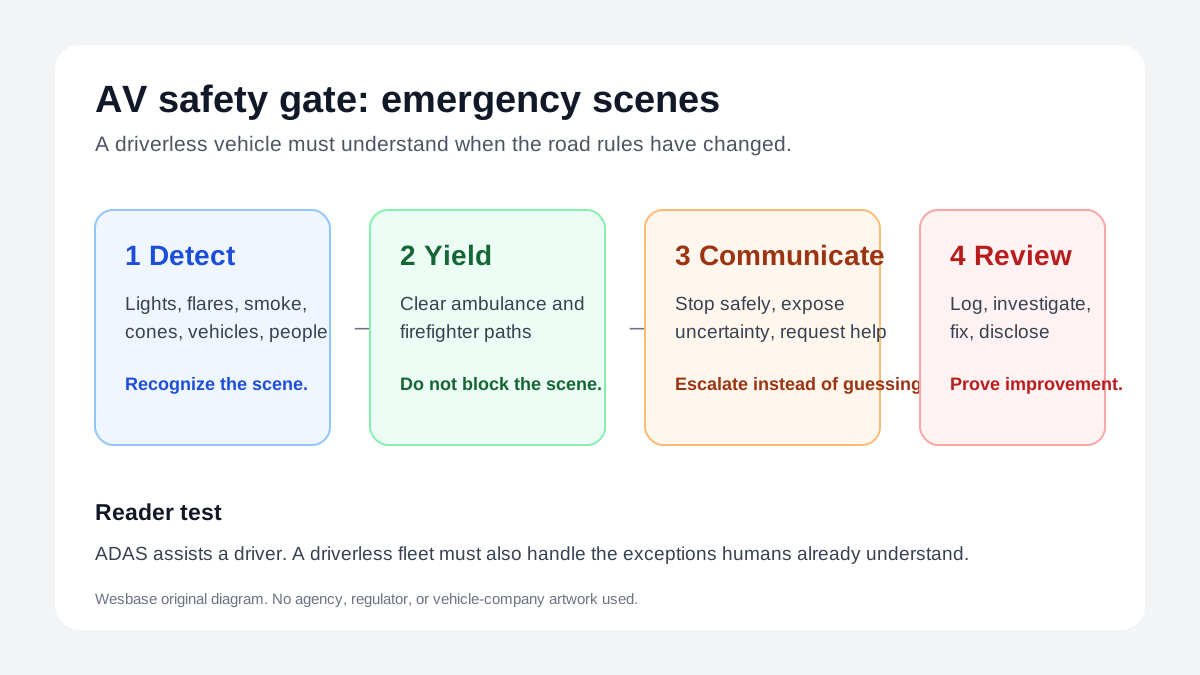
Four safety gates worth checking
| Gate | Question to ask |
|---|---|
| Detect | Can the system recognize lights, smoke, fire, flares, cones, response vehicles, and people? |
| Yield | Can it stop or reroute safely while preserving paths for ambulances, fire trucks, and police? |
| Communicate | When uncertain, can it request remote help and expose its state instead of guessing? |
| Review | Are incidents logged, investigated, fixed, and retested to demonstrate improvement? |
These are not a new NHTSA certification table. They are a reading and operations checklist derived from the public warning and the direction of the UNECE framework. They help distinguish a capability demo from evidence that a system can manage failure.
What it means for drivers and riders
If you drive a normal passenger car with lane keeping, adaptive cruise, or emergency braking, remember that these are ADAS. The driver remains responsible. A car recognizing some emergency lights or obstacles does not make it an ADS that can operate without a human within a broader domain.
If you use a driverless fleet service, look for the operator’s explanation of its service area, response to police direction, remote-assistance boundary, safe-stop behavior when uncertain, and the way incidents enter the safety-improvement process.
For cities, insurers, and fleet partners, a single demo is not enough. More useful evidence covers rain, darkness, road closures, multiple response vehicles, responder gestures, temporary barriers, and the records and fixes that follow an incident.
Confirmed facts, inference, and uncertainty
Confirmed: NHTSA issued the July 8 call to action and described several forms of failed interaction between driverless vehicles and first responders. UNECE publicly described the June adoption of a global ADS framework.
Reasonable inference: emergency-scene interaction will become an important measure of deployment maturity because it tests perception, decision-making, human assistance, operations, and governance together. That is an analysis based on the public material, not a universal score already published by a regulator.
Still uncertain: which companies, vehicles, cities, and operating conditions are involved; how often each system fails; and what verifiable remedies developers will propose by the end of July. Without that evidence, do not publish company safety rankings or incident-rate conclusions.
FAQ
Is NHTSA banning robotaxis?
No. The agency asked developers and operators to act and said it would convene them; the notice does not announce a blanket ban.
Does this apply to driver-assistance systems in my car?
It applies mainly as a boundary lesson. ADAS still requires driver attention and responsibility, while a driverless fleet must handle complex scenes within its approved operating domain.
Does the global ADS framework mean driverless cars can operate everywhere?
No. The framework creates shared safety-management and validation direction. Local approvals, operating areas, liability, and conditions still come from applicable rules.
What should I watch next?
Watch whether operators publish emergency-scene test coverage, human or remote-assistance limits, incident handling, remediation validation, and continuous monitoring—not only another hands-off mileage demo.
Image and source notes
The cover is an original Wesbase emergency-scene safety-gate diagram. It uses no NHTSA, UNECE, manufacturer logo, or media artwork. Facts come primarily from NHTSA’s July 8 news release and developer letter, with UNECE’s June ADS framework for regulatory context. The complete incident list, company attribution, failure rate, and remediation evidence remain open questions.