The Short Version
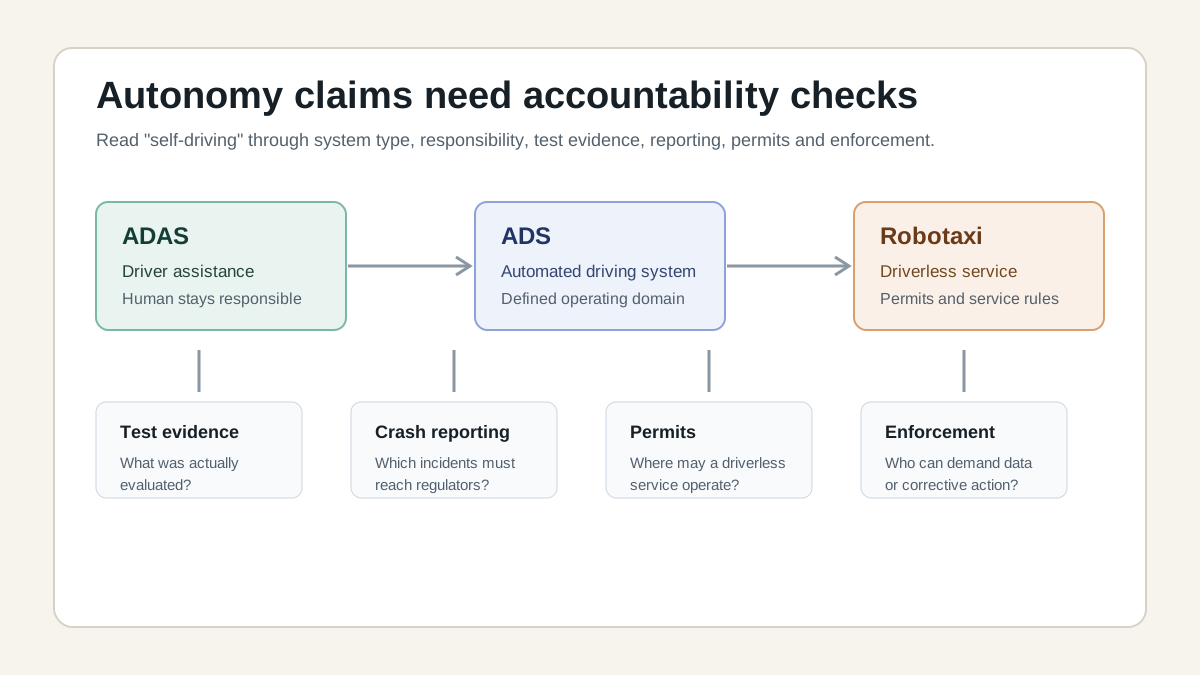
The important 2026 change in automated driving is not that one brand suddenly became fully autonomous. It is that regulators are turning vague autonomy language into questions that can be checked: Is this ADAS or ADS? Does a human driver remain responsible? What exactly was tested? Which crashes must be reported? In California, does a driverless service have a deployment permit and a passenger safety plan?
That matters for normal drivers. A sales page may put driver assistance, automated driving, smart parking, highway navigation, and robotaxis into one story. Regulators do not read it that way. They look at system boundaries, test evidence, crash data, permits, and enforcement.
So the better question is not “is this self-driving?” The better questions are: who is responsible, where does it work, what did the official test measure, who reports problems, and who can hold the operator accountable?
What Happened
The first signal came from NHTSA. On May 7, 2026, the agency said the 2026 Tesla Model Y was the first vehicle to pass its new Advanced Driver Assistance System evaluations. NHTSA placed those evaluations within the New Car Assessment Program and listed four new pass/fail areas: pedestrian automatic emergency braking, lane keeping assistance, blind spot warning, and blind spot intervention.
That announcement can be misread. It says specific ADAS active-safety functions passed specific tests. It does not say the vehicle is now a driverless car. ADAS is still assistance. The human driver still has responsibility.
The second signal is crash reporting. NHTSA’s Standing General Order requires identified manufacturers and operators to report certain crashes involving automated driving systems or SAE Level 2 ADAS vehicles. That reporting system gives regulators a path to real-world incident data, not just demos and marketing claims.
The third signal is California. California DMV announced updated autonomous vehicle regulations in 2026 covering both light-duty and heavy-duty vehicles, with stronger safety requirements, oversight, and enforcement. CPUC’s AV passenger service programs also require applicants to obtain a DMV Autonomous Vehicle Deployment Permit, and driverless pilot or deployment applicants must submit passenger safety plans.
Together, these signals show a shift from “who has the most advanced self-driving story?” toward “what system, what responsibility, what evidence, and what enforcement path?”
Why This Is Happening Now
Automated driving has moved from stage demos to real roads, real crashes, and real services.
Early autonomy debates often focused on technical vision: sensors, compute, models, maps, algorithms, and miles driven. The questions are now more concrete. Drivers already use Level 2 systems on public roads. Robotaxi services operate or seek approval in selected cities. Trucks, delivery vehicles, and transit are entering AV rulemaking.
Once a technology becomes a public-road system, regulators ask different questions. What happens when it fails? How quickly are crashes reported? How do emergency responders contact the operator? Can consumers understand safety test results? How do state deployment permits connect with federal vehicle safety standards?
That is why NHTSA’s ADAS testing and California’s AV rules belong in the same discussion. One is closer to vehicle safety evaluation. The other is closer to state deployment and enforcement. Both turn automation claims into public signals that can be checked.
ADAS, ADS, and Robotaxis Are Not the Same Thing
ADAS means advanced driver assistance systems. It can include automatic emergency braking, lane keeping, blind spot alerts, adaptive cruise control, and similar features. The important word is assistance. The driver still has to watch the road, take over, and remain responsible.
ADS means automated driving system. NHTSA’s manufacturer-facing materials focus ADS work on SAE Levels 3 through 5. The key question is not whether the feature sounds intelligent. It is whether the system performs the full dynamic driving task within a defined operational design domain.
Robotaxi is a service model. It may use ADS, but the consumer sees a passenger service: where it can be hailed, whether a human safety driver is present, how remote support works, whether there is a passenger safety plan, whether the operator has a deployment permit, and what happens after a traffic violation or crash.
Mixing these categories creates two common mistakes. One mistake is treating an ADAS test result as proof that a vehicle can drive itself. Another is treating a robotaxi permit in one operating area as proof that the technology works everywhere, in every condition.
The safer reading is simple: every autonomy claim needs a boundary. Test boundary, road boundary, weather boundary, driver responsibility boundary, service boundary, and regulatory boundary.
Who Is Affected
For consumers, the biggest change is that shopping and use decisions need more precision. Do not stop at feature names or demo videos. Look at official test categories, owner manual limits, system warnings, takeover requirements, recalls, and crash-reporting history. NHTSA’s consumer page also warns that fully universal self-driving capability is not available on today’s consumer vehicles.
For developers and product teams, the lesson is that autonomy is not only a model-capability problem. Vehicle systems, remote operations, logs, event reporting, emergency response, and human-machine interaction can all become part of the product. A feature that runs in a demo is not automatically ready for accountable deployment.
For automakers and AV operators, the signal is caution. Passing an ADAS test can support an active-safety claim. It should not be packaged as proof of ADS or driverless approval. Once a driverless service enters state permit and passenger safety frameworks, the operator faces more specific reporting, response, and enforcement duties.
For tech readers and media, the main job is to stop treating “autonomous driving” as one thing. One story may be about ADAS tests. Another may be about ADS rulemaking. Another may be about robotaxi passenger service. Another may be about crash data reporting. They are related, but they are not interchangeable.
What Is Confirmed and What Is Not
Confirmed: NHTSA has added new ADAS pass/fail categories as a public safety-evaluation signal. NHTSA still uses its Standing General Order to collect certain crash reports involving ADS and Level 2 ADAS. California DMV has updated AV rules covering broader vehicle and deployment categories. CPUC has separate requirements for AV passenger service permits and safety plans.
Also important: several things remain uncertain.
First, a vehicle passing a specific ADAS test does not mean it is safe in complex weather, construction zones, unstructured roads, or every city street.
Second, state AV rules do not create one national standard. U.S. automated vehicle regulation still splits federal vehicle safety, state road operations, local enforcement, and passenger-service oversight.
Third, crash reporting improves transparency, but public data still needs careful interpretation. Fleet size, road environment, operating area, and reporting thresholds can differ widely.
Fourth, marketing language can change quickly. Consumers should rely more on manuals, regulator pages, test categories, and service permits than on product names.
A Practical Checklist
Use six questions whenever you see a smart-driving claim.
First, is this ADAS or ADS? If the driver must supervise continuously, do not treat it as driverless.
Second, does the human driver remain responsible? If yes, the feature does not justify distraction, sleep, or leaving the driver’s seat.
Third, what did the official test actually measure? NHTSA’s ADAS tests focus on specific active-safety functions, not every automated-driving scenario.
Fourth, how are crashes and anomalies reported? Certain crashes involving Level 2 ADAS or ADS may fall into NHTSA’s reporting framework.
Fifth, if this is a driverless service, does it have local deployment authorization, a passenger safety plan, and remote-support requirements?
Sixth, what can enforcement authorities do? One point of California’s updated rules is to make oversight and enforcement more concrete than a company’s own description.
What To Watch Next
The first thing to watch is whether NHTSA’s ADAS tests cover more vehicles and become a metric consumers actually compare. The tests become more useful when multiple vehicles are judged against the same public criteria.
The second is how California’s updated rules translate into robotaxi, freight, and transit operations. The real story is not only the rule text. It is permits, reporting, emergency response, and enforcement cases.
The third is whether automakers narrow their marketing language. The more regulators emphasize tests, reporting, and responsibility, the harder it becomes to describe driver assistance as unrestricted self-driving.
FAQ
Does passing an NHTSA ADAS test mean a car can drive itself?
No. It means specific ADAS functions passed specific tests. Consumers still need to check whether the system requires supervision and where it is allowed to operate.
Why are ADAS and ADS so often confused?
Because marketing language often mixes terms such as smart, automatic, pilot, navigation, and full self-driving. Regulators separate systems by responsibility and operating domain, not by product names.
Do California AV rules affect every U.S. state?
Not directly. But California is a major AV testing and robotaxi market, so its rules can affect operator costs and become a reference point for other jurisdictions.
Should consumers trust smart-driving features more or less now?
They should distinguish them more carefully. Active-safety and driver-assistance systems can be valuable, but they are not unconditional self-driving. Stronger features need clearer responsibility boundaries and official evidence.
Does this slow autonomous driving commercialization?
Not necessarily. Clearer rules can reduce long-term uncertainty. In the short run, companies need more safety and compliance evidence. In the long run, testable, reportable, and enforceable frameworks are better for scaled services.