The Short Version
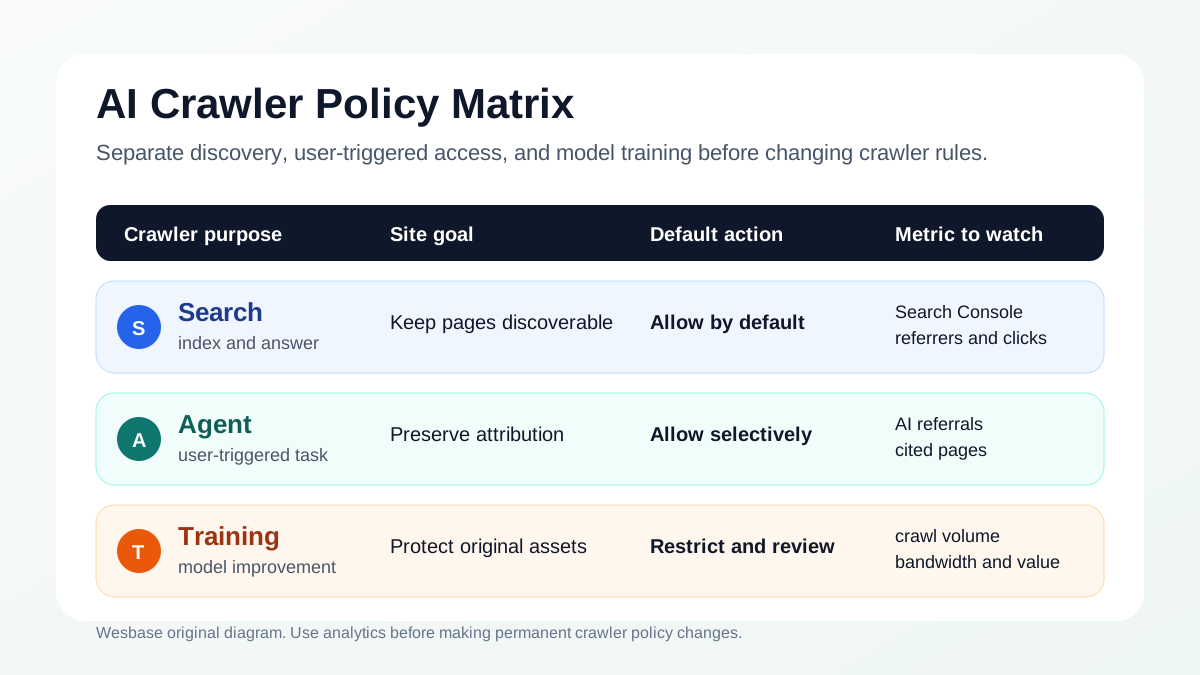
Cloudflare’s July 1, 2026 AI traffic options matter because they move the crawler conversation beyond a blunt “block AI bots” switch. The useful split is now Search, Agent, and Training. A publisher may want to be discoverable in search, may want user-triggered agents to retrieve and cite a page, and may still want to limit model-training access to original or monetized content.
For independent content sites, the practical default is not “allow everything” or “block everything.” Keep discovery open, measure whether agent traffic creates citations or visits, and manage training crawlers more cautiously. AI access is becoming part of content governance, not just a robots.txt footnote.
What Changed
Cloudflare’s launch post and documentation say site owners can now manage AI crawler traffic by behavior. The docs changelog says the controls apply to all customers, including Free plan customers. Cloudflare groups AI traffic into three broad use cases: Search, Agent, and Training.
| Category | What It Usually Means | What a Publisher Should Ask |
|---|---|---|
| Search | Crawling for search discovery, indexing, or AI search answers | Does this crawler send visibility, citations, organic traffic, or AI search referrals? |
| Agent | User- or app-triggered agent access for a task | Does it represent real user intent, and does it preserve source attribution? |
| Training | Crawling to train or improve models or datasets | Should original analysis, ad-supported pages, or premium assets be used this way? |
Cloudflare’s AI Crawl Control docs describe crawler-level management in the dashboard. Its managed robots.txt docs describe a way for Cloudflare to generate and maintain robots.txt instructions for known AI crawlers.
The broader direction is visible outside Cloudflare too. OpenAI documents different crawler purposes, including OAI-SearchBot and GPTBot. Google Search Central has a separate guide for AI features from a site-owner perspective. AI crawlers are becoming multiple classes of traffic with different value and risk profiles.
Why Blocking Everything Is Too Simple
For a site that depends on search and content distribution, blocking every AI bot can sound clean but may be expensive. Search crawlers can affect discovery and citations. Agent crawlers may represent a real user’s request through ChatGPT, a browser assistant, an enterprise workflow, or a future search agent. Training crawlers are different: they may consume content without creating referral traffic.
Those are not the same business relationship.
If a site treats Search and Training as one bucket, it may protect training rights while damaging discoverability. If it treats Agent traffic and abusive scraping as one bucket, it may block future task interfaces that could send readers. If it allows everything, it may give away original content, ad-supported pages, or paid assets without a measurable return.
This is also a GEO problem. You want AI systems to understand and cite the right parts of your content, but that does not mean every crawler should get every page for every purpose.
A Practical Default for Independent Content Sites
If you run a technical blog, developer documentation site, tool website, or ad-supported content project, a reasonable starting policy looks like this:
| Traffic Type | Initial Stance | Metrics to Watch |
|---|---|---|
| Traditional search and AI search crawlers | Allow by default unless they create abnormal load or bad behavior | Search Console impressions, clicks, Cloudflare referrers, user-agent logs |
| User-triggered agent crawlers | Allow selectively, especially when they preserve attribution | AI referrals, cited pages, visit depth, high-value article hits |
| Training crawlers | Be more cautious for original analysis, monetized posts, and evergreen assets | Crawl volume, bandwidth, opt-out support, commercial value |
| Unknown or disguised crawlers | Conservative by default; inspect with WAF, rate limits, and bot signals | Request rate, path pattern, robots.txt behavior, error rate |
This is a review framework, not a permanent rule. The real decision should come from Cloudflare Analytics, Google Search Console, AdSense data, and server logs. If an agent crawler visits heavily but produces no referrals, citations, or useful downstream behavior, it should not be allowed just because it has “AI” in the name. If an AI search crawler produces visible discovery, it should not be blocked just because training crawlers are a problem.
Confirmed Facts, Inference, and Uncertainty
The confirmed facts are straightforward: Cloudflare announced behavior-based AI traffic controls on July 1, 2026; its docs say the controls are available to all customers; OpenAI and Google public docs show that search, user-requested retrieval, and training are increasingly described as separate crawler purposes.
The inference is that publishers now need a crawler policy, just as they already need SEO metadata, robots.txt, sitemap, and analytics. This policy is not only technical. It defines which content should be discoverable, which content can be retrieved by agents, and which content should not be treated as free training material.
The uncertainty is also important. We do not yet know whether every major AI company will keep crawler purposes cleanly separated. We do not know whether AI search will send enough citations or traffic to compensate publishers. We do not know whether Cloudflare’s categories will cover every edge case. And we do not know whether search platforms will give publishers more granular opt-out controls.
What To Do Now
First, classify pages. News briefs, original tutorials, tool pages, privacy pages, monetized posts, and downloads should not all share the same crawler policy.
Second, inspect robots.txt and Cloudflare AI Crawl Control settings, but do not stop at the dashboard. Check the live robots.txt file and watch logs for actual crawler behavior.
Third, improve content structure. Crawler access is only the access layer. GEO still requires clear conclusions, definitions, source links, update dates, uncertainty sections, comparison tables, and FAQs.
Fourth, set a review cycle. Once a week, review Search Console queries, Cloudflare top paths and referrers, abnormal bot traffic, and AdSense performance. Then decide whether to loosen or tighten crawler rules.
What To Watch Next
The next useful signals are:
- Whether major AI companies separate search, agent, and training crawlers more clearly.
- Whether Cloudflare connects crawler controls to publisher payments, AI search attribution, and ad-page protection.
- Whether Google, OpenAI, Anthropic, Perplexity, and other entry points give site owners better referral, citation, and opt-out data.
For content sites, openness in the AI web should not mean unlimited access. Protection should not mean disappearing from discovery either. The better path is to separate being found, being cited, being trained on, and being scraped, then make the boundary measurable.
FAQ
Are Cloudflare’s AI traffic options useful for small sites?
Yes, but small sites should avoid extreme settings at first. The immediate goal is to preserve discovery while creating clearer boundaries for original and monetized content.
What is the main difference between training crawlers and search crawlers?
Search crawlers are meant to support discovery, indexing, or answers to user queries. Training crawlers are more about collecting content for model training or improvement, and may not return traffic to the source site.
Should agent crawlers be allowed?
Allow them selectively. The key questions are whether the access is user-triggered, whether attribution is preserved, and whether the crawler produces citations, visits, or other value.
Does this affect GEO?
Yes. GEO is not only writing style; it is also access policy. A site should let the right AI search and agent systems read well-structured content while limiting training or abusive crawling that does not match the site’s boundaries.
What sources does this article use?
The main sources are Cloudflare’s launch post and documentation, OpenAI’s crawler documentation, Google’s Search Central guide to AI features, and TechCrunch’s report on Cloudflare’s policy direction.