Do this in the next 30 minutes
If you rely on custom agents inside Doubao or Qwen, do not start by chasing a replacement app. Start by turning each important agent into a local migration package.
The smallest useful package has five parts:
| File | What to save | Why it matters |
|---|---|---|
persona.md | Name, role, tone, boundaries, taboos | Defines who the agent is |
prompt.md | System prompt, opening line, fixed instructions | Defines how it works |
knowledge/ | Uploaded documents, notes, links, spreadsheets | Defines what it knows |
workflow.md | The steps you ask it to follow | Defines what it does |
memory.md | Key chat summaries, preferences, long-term context | Makes rebuilding possible |
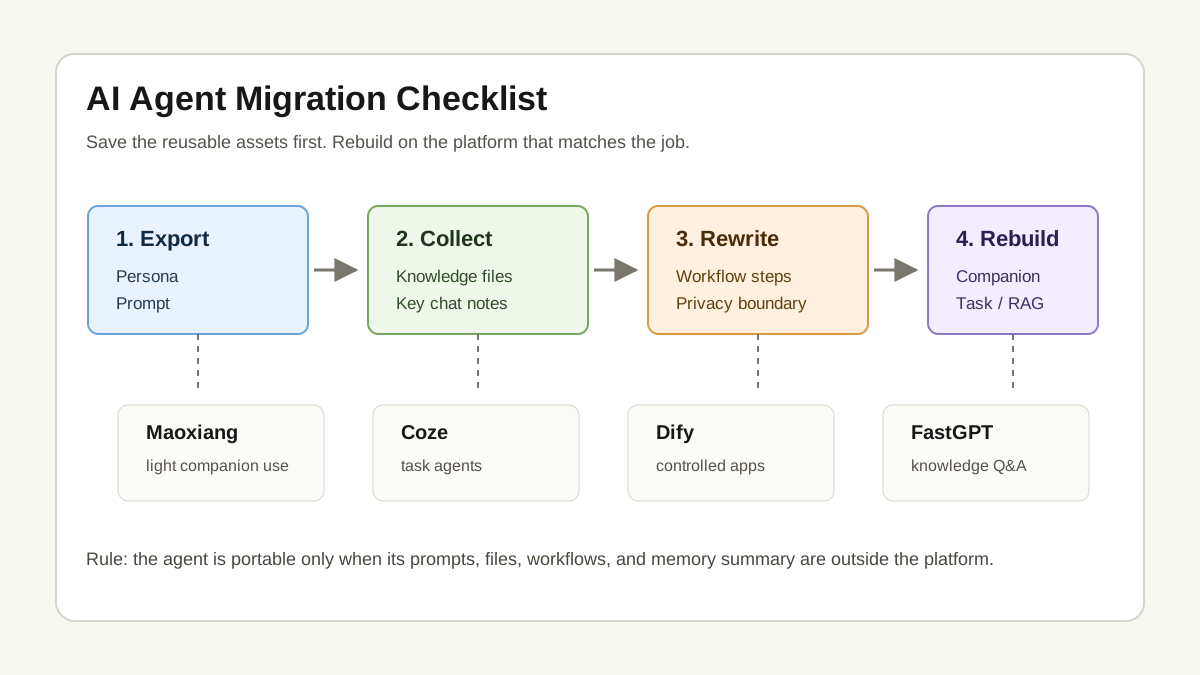
This matters more than the new platform. If those assets are outside the platform, you can rebuild a lighter version in Maoxiang, a task agent in Coze, a controlled app in Dify, a knowledge-base assistant in FastGPT, or even a simple Markdown-plus-model workflow.
What happened
Chinese media reports say Doubao and Alibaba Qwen notified users that agent-related features will go offline on July 15, 2026. Reports also say Doubao agent data will no longer be viewable or restorable inside Doubao after October 15, 2026. Doubao points users who still want to create and use agents toward ByteDance’s Maoxiang app.
The reaction across public social platforms has been emotional and practical at the same time. Some users are upset about losing long-running characters. Some complain that tool-like agents and emotional companion agents are being swept together. Others are already sharing backup, screenshot, export, and rebuild methods.
Those posts are not a statistical survey. But they reveal the real issue: for many users, an agent is no longer just a feature. It is a personal asset.
What the policy actually targets
The policy background is China’s interim regulation on anthropomorphic AI interaction services, which takes effect on July 15, 2026.
The regulation focuses on AI services that simulate human personality traits, thinking patterns, communication styles, or human-like images and voices for ongoing anthropomorphic interaction. It pays special attention to emotional dependency, addiction, emotional manipulation, minor protection, identity labeling, data deletion, and user exit mechanisms.
That is not the same as banning every AI assistant. The regulation also excludes scenarios that do not involve persistent emotional interaction, including intelligent customer service, knowledge Q&A, work assistants, learning and education, scientific research, health consultation, and cultural or entertainment uses.
So the practical reading is narrower: large platforms are reassessing open-ended, user-created, long-running agent spaces that can become strongly anthropomorphic. Task agents, knowledge-base assistants, and workflow automation are not disappearing, but they will be more boundary-aware.
Migrate assets before platforms
The most common question is: what should replace Doubao agents?
That question comes too early. What you need to migrate first is not the character shell. It is the reusable asset behind it.
An agent usually has five layers:
| Layer | Example | Migration format |
|---|---|---|
| Persona | Name, identity, tone, relationship boundary | persona.md |
| Instruction | Output format, refusal rules, goals | prompt.md |
| Knowledge | Files, course notes, project material | knowledge/ |
| Workflow | How it analyzes, outputs, and checks work | workflow.md |
| Memory | Preferences, background, key conclusions | memory.md |
Screenshots preserve memories. A copied persona preserves the skin. The things that let an agent come back to life elsewhere are prompts, files, workflows, and summaries.
Copy this migration template
Create a folder like this:
my-agent-backup/
  persona.md
  prompt.md
  workflow.md
  memory.md
  knowledge/
    source-list.md
    files/
Use persona.md for the character and boundaries:
# Persona

Name:
Purpose:
Tone:
Strengths:
What it must not do:
Best user scenarios:
Expressions to avoid:
Use prompt.md for reusable instructions:
# System Prompt

You are...
Your goal is...
Every answer must...
You must not...
When information is missing...
Output format...
Use workflow.md for the actual task:
# Workflow

1. What I provide as input
2. What the agent checks first
3. What questions it asks before working
4. What output format it returns
5. How I verify the result
6. When a human must take over
Use memory.md as a summary, not a raw transcript:
# Memory Summary

Long-term preferences:
Project background:
Common terms:
Key conclusions:
Do not ask me again:
Sensitive content that must not be saved:
This looks plain, and that is the point. Plain files survive product changes.
How to choose a replacement
Do not rebuild every agent in one place. Pick the replacement based on the job.
| Use case | Better direction | Best fit |
|---|---|---|
| Light companion or character interaction | Maoxiang-style companion apps | Users who want role interaction without storing sensitive data |
| Task agents | Coze | Content, customer service, information collection, automation |
| Controlled AI apps | Dify | Model routing, workflow, RAG, app publishing, team control |
| Knowledge-base Q&A | FastGPT | Documents, notes, courses, internal knowledge |
| Minimal personal setup | Markdown plus a general AI model | Users who want portability over platform features |
My practical recommendation is simple. If the agent mostly talks with you, look at companion apps, but reduce privacy and emotional-dependency risk. If it helps you write, organize, summarize, or automate, start with Coze. If you want a more controlled AI application stack, use Dify. If the main job is asking questions against documents, FastGPT is closer to the shape of the work.
Three rebuild paths
The first path is companion rebuilding. Move only a light persona and safe tone notes. Do not migrate full private chat logs. Do not move identity documents, family conflicts, medical records, payment details, account credentials, raw trauma logs, or private relationship conversations into another companion app.
The second path is workflow rebuilding. Put prompt.md and workflow.md into Coze or Dify. The goal is not to make the new agent speak exactly like the old one. The goal is to make it reliably finish the job: draft posts, summarize materials, prepare notes, collect information, or format reports. A workflow agent should have clear inputs, clear outputs, and a human review step.
The third path is knowledge-base rebuilding. Clean up the files under knowledge/, then import a small set into FastGPT or Dify first. Test retrieval before uploading everything. If the assistant answers incorrectly, you need to know whether the problem is the document, the chunking, the prompt, or the model.
What not to migrate
Before migration, delete aggressively.
Do not migrate passwords, verification codes, payment data, identity documents, passports, home addresses, phone numbers, confidential company files, unpublished contracts, medical records, counseling notes, raw intimate conversations, or minors’ private information.
Also avoid rebuilding a companion agent as “the person who will never leave.” That sounds cold, but it matters. AI can provide a sense of companionship, help you sort thoughts, and help you phrase emotions. It is not a therapist, a real-world relationship, or a substitute for human judgment.
The best personal AI system should give you more control over your material and decisions, not make you more dependent on one platform.
A one-hour version
If you only have one hour, do this:
- List your three most important agents.
- Save each agent’s persona, opening message, and reusable prompt.
- Download or re-save every uploaded knowledge file.
- Summarize the key memory in ten sentences instead of copying full chats.
- Mark content that must never be migrated.
- Assign each agent one rebuild path: companion, task, knowledge base, or minimal prompt.
- Rebuild only the most important one first, then test it on three real tasks.
That is enough. Do not migrate a dozen characters in one night. Rushed migration tends to move junk memory, sensitive details, and broken prompts along with the useful parts.
How to avoid this next time
The lesson is not that one platform is unreliable. The lesson is that important agents need a portable version.
For every important agent you create, keep five files outside the platform: persona.md, prompt.md, workflow.md, memory.md, and knowledge/.
The platform runs the instance. Your local files keep the asset.
If another product changes direction later, you lose the shell, not the method.
FAQ
Should I export all chat history?
Usually no. Chat logs are long, but the reusable parts are preferences, background, conclusions, and workflow. Summaries are safer and easier to rebuild from.
Which tool is most similar to Doubao agents?
If you mean character companionship, Coze, Dify, and FastGPT are not direct replacements. If you mean agents that complete tasks, Coze is easier to start with, Dify is more controlled, and FastGPT is better for document Q&A.
Will the new policy shut down all AI agents?
Based on the public policy text, no. Persistent anthropomorphic and emotional interaction is the focus. Task assistants, knowledge Q&A, education, research, and ordinary work use cases continue, but platforms will care more about labeling, review, boundaries, and data handling.
Is there still time?
Yes. Save important agent material before July 15, 2026. If the reported Doubao data window applies to your account, also make sure needed data is outside the platform before October 15, 2026.
What is the safest personal setup?
Keep core assets in Markdown first, then choose a platform to run them. Do not store all prompts, files, memory, and workflow logic only inside one app.