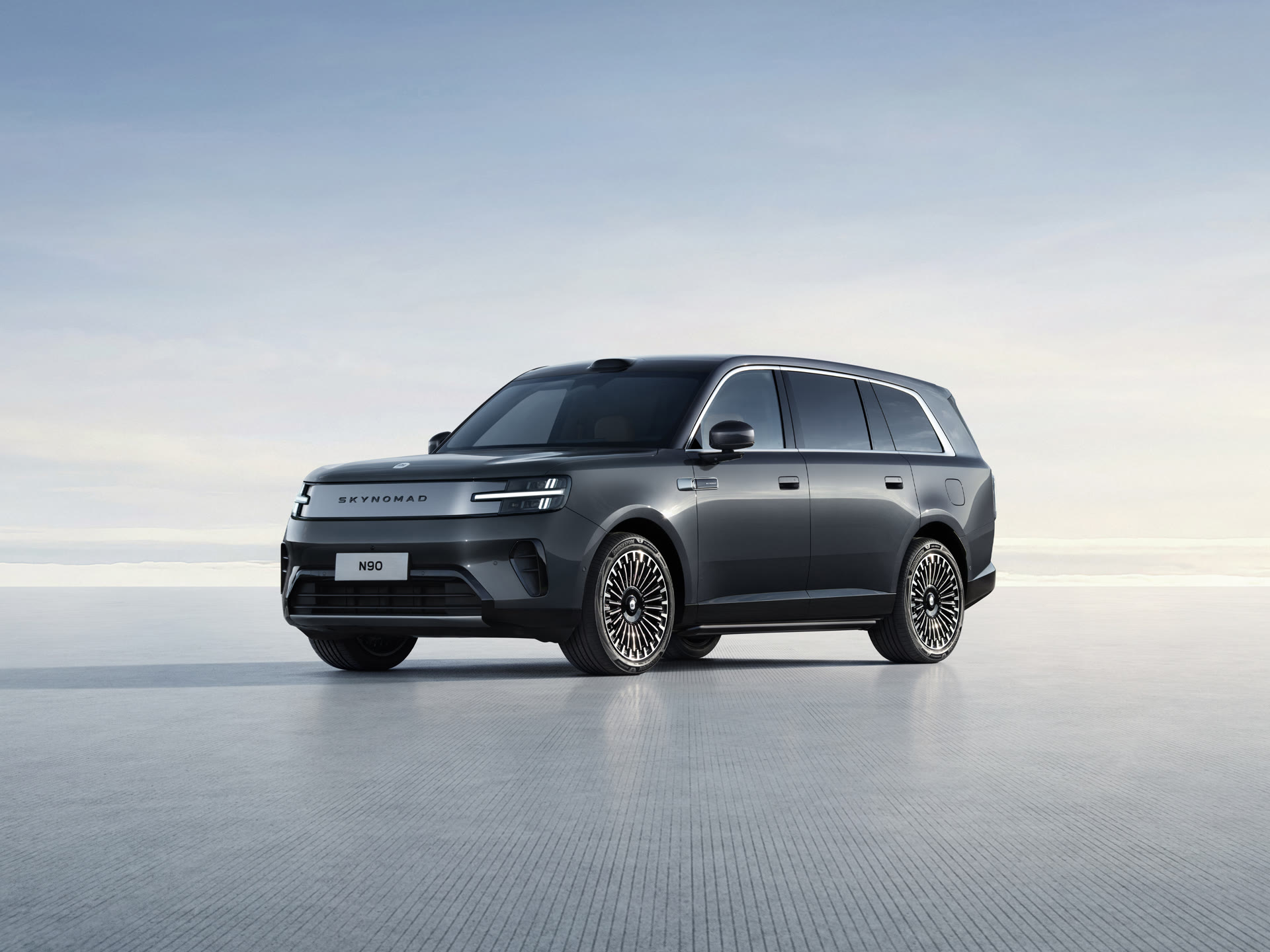
The most revealing part of Xiaomi’s latest vehicle filings is not a 380-kilometre electric range or the N90 badge. It is an awkward regulatory label: plug-in range-extended hybrid cultural life service vehicle.
Bureaucratic language is rarely poetic. This one accidentally sounds like a forecast. A car is no longer being asked only to move people. It is being designed to host rest, work, socialising and an occasional night of sleep.
Xiaomi calls the series SkyNomad, or Pengcheng in Chinese. It is not a separate brand. SU7 and YU7 are the driving-oriented lines; SkyNomad is Xiaomi’s attempt to make people more comfortable after the vehicle stops.
Four filings, two bodies
Xiaomi publicly describes an initial two-model range with five- and seven-seat layouts. The regulatory batch contains four configurations that media commonly call N70, N70 Max, N90 Max and N90 Max camping. They are not four unrelated vehicles.
| Filing | Dimensions (L×W×H) | Seats | Drive and battery | WLTC EV range | Charge-sustaining fuel use | Curb weight |
|---|---|---|---|---|---|---|
| N70 | 4,960×1,998×1,785mm | 5 | 210kW RWD; 52kWh Sunwoda LFP | 265-270km | 5.7-5.8L/100km | 2,453-2,505kg |
| N70 Max | 4,960×1,998×1,765mm | 5 | 210+100kW AWD; 76kWh CALB NMC | 375-380km | 6.1-6.2L/100km | 2,561-2,610kg |
| N90 Max | 5,285×1,998×1,825mm | 5 / 7 | 210+100kW AWD; 76kWh CALB NMC | 370km | 6.26L/100km | 2,800kg |
| N90 Max camping | 5,285×1,998×1,925mm | 5 | 210+100kW AWD; 76kWh CALB NMC | 363km | 6.28L/100km | 2,840kg |
All four use a 1.5-litre range extender from Dongan with 112kW net output and list a 190km/h top speed. Xiaomi’s exact wording is that “the SkyNomad series exceeds 500 kilometres of electric range under CLTC,” but it has not publicly mapped that claim to each configuration. The filing values are the safer comparison for now.
The filings also contain less glamorous details that will help with later fact-checks. All four list Bosch ESP10, an event data recorder and optional ETC. N70 configurations offer 19- or 21-inch tyres and gross weights from 2,892 to 3,049kg. N90 Max uses 21-inch tyres and lists 3,265 / 3,361kg gross weight. Powered steps, wheel designs, door handles, badges and several trim pieces appear as options.
The N90 has a 3,080mm wheelbase. Public material shows front seats that rotate through 360 degrees, long cabin rails and a movable centre console that can support face-to-face seating, work or rest. The seven-seat layout is claimed to hold at least seven suitcases of unspecified size. Xiaomi CTO Hu Zhengnan says it was the team’s first vehicle developed from interior scenarios and functions outward, with exterior hard points determined later.
The camping version adds a pop-up roof, roof bed, side cabinet and awning interface, with an optional projector and removable table. Its roof may only be operated while parked and off public roads. It is a vehicle that becomes a room only after it stops.
Xiaomi says 566 development vehicles had covered 4.28 million kilometres by 30 June 2026, in temperatures from -41°C to 53°C and at elevations up to 5,380 metres. That is meaningful validation for Xiaomi’s first range-extended platform. It is not evidence for bed comfort, insulation, sanitation or parking power.
The boundary between car and home loosens at the living room
“Young Chinese people no longer want homes” is too convenient a slogan.
China’s National Bureau of Statistics reported total retail sales up 1.4% in the first five months of 2026, while May fell 0.6% year on year. New commercial-property floor area sold fell 10.8% in the same five months, including a 12.1% fall for residential property. Consumption and housing are weak; the figures do not prove that every young person shares one attitude.
The more useful shift is that more people hesitate to lock decades of cash flow into one fixed space. A housing-rental white paper from Tsinghua PBCSF estimates that more than 70% of young people and new urban residents in major cities meet their housing needs through renting.
Renters still want a larger living room, a quiet office and a private place outside the city. They simply do not need one home to provide every function.
Sleep can remain in a small flat. Showers stay at a fixed address. Work moves to a shared office, socialising to a cafe, and weekends to a vehicle that can seat people face to face, run devices and host one night of sleep.
SkyNomad is therefore not competing first for the bedroom. It is competing for the expensive living room that is used only a few hours a day.
It beats an RV by being usable every day, and loses by being hard to live in
A representative B-class camper such as JMC’s Fuxiniu is about 5.99×2.09×2.63 metres. A C-class SAIC Maxus Life Home V90 is about 5.99×2.42×3.08 metres. The N90 camping version is 5.285×1.998×1.925 metres.
The Xiaomi is still large, but its closed height remains below two metres. Urban access, parking and highway driving should be far more plausible than in a conventional motorhome. The extra width and height of an RV are not wasted, however. They buy standing room, fixed beds, kitchens, sanitation and storage.
| Living dimension | SkyNomad N90 camping | Representative B/C-class RV |
|---|---|---|
| Daily driving | Large-SUV proportions and passenger-car performance; easier urban access | Roughly 6m long and 2.6-3.1m high; parking and clearance are limiting |
| Seated work and rest | Rotating seats, long rails and passenger-car seating and climate control | Squarer room, but more compromises while driving |
| Sleep | Pop-up roof and roof bed confirmed; size, load, noise and insulation unknown | Fixed beds or complete convertible beds are common |
| Standing | Interior height with the roof raised is undisclosed | Stable standing room is a core feature |
| Toilet and shower | No fixed toilet, shower or black-water system disclosed | Full motorhomes normally include a bathroom |
| Water | Fresh, grey and waste-water systems undisclosed | Example models carry roughly 120-155L fresh and 23-85L grey water |
| Household power | 76kWh is a traction battery; export power and parking-HVAC rules are unknown | Example C-class model specifies a 10kWh house battery and appliances |
| Multi-day living | Better suited to weekends and occasional nights | Better suited to continuous travel, with higher ownership costs |
The easy mistake is to see 76kWh and declare victory over motorhomes. Traction capacity is not the same as usable house energy. Until Xiaomi discloses export power, parking-HVAC behaviour, low-charge protection and whether the range extender can support stationary loads, that figure is potential, not delivered habitation.
Payload is another hard boundary. The camping model lists 2,840kg curb weight and 3,305kg gross weight, a difference of only 465kg. Occupants, luggage, the roof system, cabinetry and camping gear all consume that allowance. Large tanks, a fixed bathroom, thick insulation and a full kitchen cannot be added for free.
The moat around a real RV is not a bed. It is the ability to spend three days away from hotels and public toilets.
The RV most at risk is the one that spends most of the year parked
The N90 will not erase full C-class motorhomes. Long-distance travellers still need a fixed bed, shower, toilet, water, waste handling, insulation and durable household power. Rotating seats cannot solve those physical requirements.
The vulnerable segment is the lightly converted camper bought for a handful of weekends, then stored separately because it is awkward to commute in and expensive to park.
If SkyNomad can be registered, serviced and driven like a large SUV while delivering a good bed, reliable parking air conditioning and useful export power, many households will not buy a second specialist RV. Not because the Xiaomi is better to live in, but because it may be useful on two hundred more days each year.
RV makers will be pushed in opposite directions. Some products will become cheaper, lighter and modular. Others will make sanitation, energy, insulation and long-stay comfort radically better than any SUV. The middle ground, little more than an MPV with a bed but much harder to drive, will hurt most.
I am not betting on a car-dwelling boom. I am betting on mobile living rooms
China is unlikely to see mass permanent car dwelling. Heat and cold, parking rules, showers, waste, night-time safety, stable connectivity, deliveries and social ties are not solved by a pop-up bed. Romantic stories about vehicle living often treat fixed urban infrastructure as if it were free.
The more credible three-year shift is a small rental that stays small, plus a living room that moves.
Young consumers may use a vehicle as a weekend bedroom, temporary meeting room, studio, gaming room and exit from the city. It does not replace the square metres used every night. It can replace an occasional cafe, hotel, living room and idle RV.
By 2028, mainstream automakers will chase the formula: roughly two metres high when closed, a pop-up roof, five seats and passenger-car drivability. Buyers will quietly add a new metric to range and acceleration: usable square metres multiplied by comfortable hours.
Campsites will change too. Showers, laundry, water, waste disposal, charging, reliable connectivity and rentable storage will matter more than decorative photo spots. The vehicle carries the mobile half of life; the site sells the missing infrastructure.
Real estate will not be defeated by one car. The deeper change is that functions once bundled into a home are being unbundled one by one. When work, entertainment, social space and short stays can be purchased on demand, an expensive living room is no longer automatically worth a thirty-year mortgage.
SkyNomad may not be a young buyer’s first home. It may be the first mainstream car willing to admit that it is competing for time once owned by housing.
What Xiaomi still has to answer
As of 15 July 2026, Xiaomi has not announced final pricing or launch timing. It has not fully disclosed roof-bed dimensions and load, raised-roof standing height, insulation, parking HVAC, power export, fresh and waste water, toilet or shower capabilities.
These are not footnotes. They determine whether the camping version crosses from a large SUV into a credible light RV. Price decides which segment it attacks; the living systems decide whether users stay.
As with evaluating ADAS after new-car safety rules change, a new regulatory category is only the starting point. Production equipment, maintenance costs and independent testing determine the real experience.
FAQ
Are there two SkyNomad models or four?
Xiaomi says the initial range has two models. The regulatory catalogue contains four configurations. N70, N70 Max, N90 Max and N90 Max camping are useful labels for comparison, not evidence of four unrelated architectures.
Can the N90 camping model support full-time living?
The evidence is not there yet. A roof bed solves one night of sleep. Full motorhome living also requires standing room, insulation, sanitation, water, waste handling and durable household energy, none of which has been fully disclosed.
Will it force RV prices down?
Pricing is unknown. If the production vehicle retains large-SUV daily usability and adds a good bed, parking air conditioning and export power, entry B-class campers and light conversions will face pressure first. Full C-class motorhomes will instead emphasise long-stay capability.
Image and source note
The cover is an official Xiaomi N90 product image, resized without changing its content. Vehicle specifications come from Xiaomi’s public Q&A, regulatory filings and cross-checked reports. Consumption and real-estate figures come from China’s National Bureau of Statistics. RV dimensions and living systems use public SAIC Maxus and JMC models as representative examples, not universal specifications. Predictions about unbundled housing, mobile living rooms and the 2028 product shape are the author’s analysis, not Xiaomi’s roadmap.