Bottom line
AI servers are not literally taking every memory chip out of your next phone. But they are changing the center of gravity in the memory market. On July 3, TrendForce forecast that conventional DRAM contract prices would rise 13-18% quarter over quarter in 3Q26, while NAND Flash contract prices would rise 10-15%. That matters for phones because RAM and storage are core parts of the bill of materials.
For consumers, the practical effect is not that every handset instantly becomes 20% more expensive. The more likely budget-phone problem is subtler: less RAM at the same price, smaller storage tiers, pricier high-end variants, or cuts to the display, camera, charger, build quality, and update policy.
So the 2026 budget-phone question is not just “What is the cheapest launch price?” It is “How many comfortable years will this phone give me?”
What changed
Memory prices remain under pressure in 2026. TrendForce’s 3Q26 forecast gives two numbers that matter: conventional DRAM contract prices are expected to rise 13-18% QoQ, and NAND Flash contract prices are expected to rise 10-15%. TrendForce also notes that high baselines and consumer cost limits are slowing the pace, while AI server demand and hyperscale data-center investment continue to support the market.
Tom’s Hardware summarized the same TrendForce data as a split market: server demand remains strong, while consumer electronics are running into affordability limits. Business Insider reported that UK electronics retailer Currys expects smartphone and laptop prices to face pressure later in 2026 because of memory shortages tied to AI data-center demand.
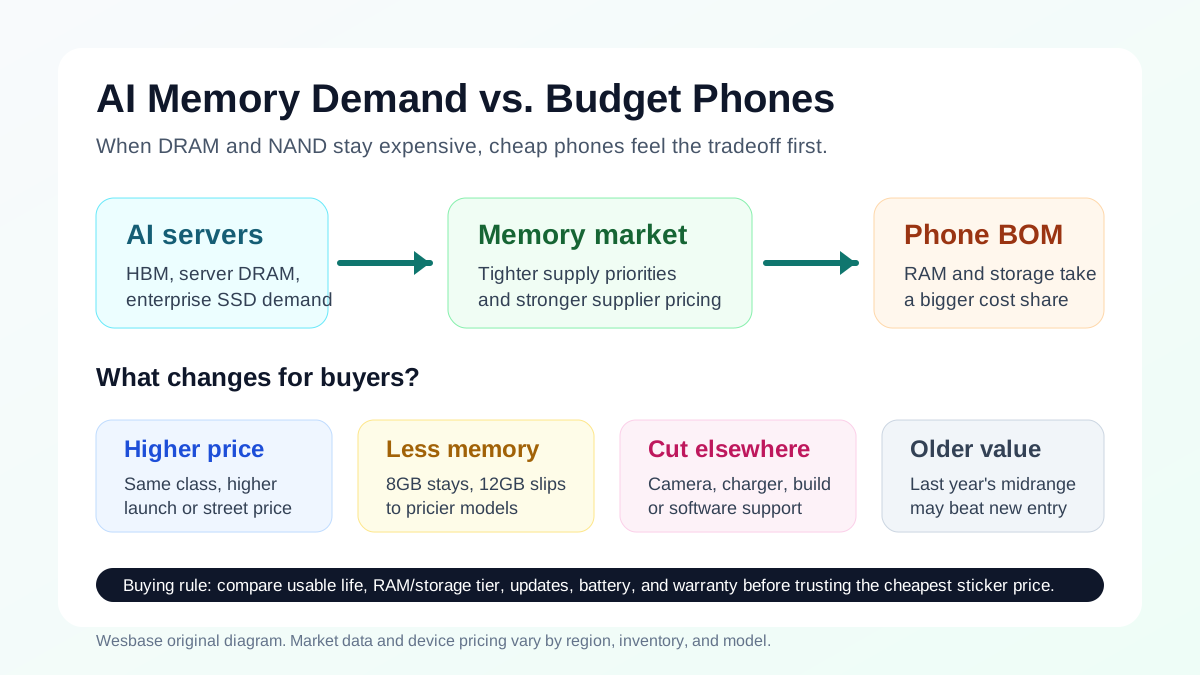
The chain looks like this:
| Link | What is happening | Why phone buyers should care |
|---|---|---|
| AI data centers | Training and inference servers need more high-end memory and enterprise storage | Memory suppliers prioritize higher-value demand |
| Memory market | DRAM and NAND prices keep rising, even as consumer demand weakens | Phone makers have less room to lower component costs |
| Budget phones | Thin margins make memory cost more painful | Brands may raise prices, reduce RAM/storage, or cut other parts |
| Consumers | Same budget buys fewer strong options | Buyers need to compare useful life, not only sticker price |
Why cheap phones feel it first
Premium phones have more margin. They can absorb some cost through camera systems, materials, services, financing, and brand pricing. Cheap phones have less room.
Imagine an entry-level phone that used to win with “8GB RAM, 256GB storage, big battery, low price.” When memory and storage costs rise, the brand has only a few options:
| Brand response | What you see | Buyer risk |
|---|---|---|
| Raise the price | Same class, higher price | Over budget, but specs stay intact |
| Hold the price | 12GB becomes 8GB, 256GB becomes 128GB | The phone feels older sooner |
| Cut elsewhere | Camera, display, charger, build, haptics, or speakers get weaker | The spec sheet may hide the real tradeoff |
| Shorten support | Fewer OS or security updates | Software expires before the hardware does |
| Push upgrades | Base model stays cheap, useful version costs more | You pay extra for the configuration you actually need |
This is why an “AI phone” label is not enough. On-device summaries, photo editing, call transcription, and private AI features can be useful, but they do not replace enough RAM, enough storage, a healthy battery, and a long update window.
Facts, inference, and uncertainty
The confirmed facts are clear: TrendForce expects DRAM and NAND prices to keep rising in 3Q26; several reports connect memory pressure to AI server and data-center demand; and retail signals now point to pressure on phones and laptops.
The reasonable inference is that low-cost phones are more exposed than flagships because memory and storage take a larger share of a low-end phone’s cost structure. Brands may respond with price increases, weaker base specs, different regional configurations, or more aggressive upselling to higher storage tiers.
What remains uncertain is the exact impact by country, brand, and model. Inventory, carrier subsidies, promotions, exchange rates, and consumer weakness can hide or amplify the memory-price effect.
There is also an important technical boundary: HBM, server DRAM, phone LPDDR, and UFS storage are not the same product. The consumer impact is mostly indirect through capacity allocation, supplier pricing power, investment priorities, and overall memory-market tightness.
Budget-phone buying matrix
If you need to buy an affordable phone now, start here:
| Check | Practical floor | Why it matters |
|---|---|---|
| RAM | At least 8GB for most people; 12GB for heavier multitasking | Low-RAM phones age faster |
| Storage | Prefer 256GB; 128GB only for light users | Photos, video, chat apps, maps, and the OS keep growing |
| Updates | Three years of security updates is a safer floor | Cheap phones often fail on software lifespan |
| Battery | Look at capacity, charging, and replacement cost | Budget phones are often kept for longer |
| Display and camera | Trade off based on your use, not pixel counts | Cost cuts often hide in experience details |
| Used or previous-gen phones | Check battery health, warranty, and update policy | Last year’s midrange phone may beat a new entry-level model |
One simple rule: for messaging, maps, payments, social apps, and short video, 8GB RAM plus 256GB storage plus a decent update policy is usually more valuable than a flashier new phone stuck at 128GB. If you shoot lots of video, play games, or store files locally, prioritize storage and thermals earlier.
Buy now or wait?
If you need a phone now, do not wait forever because of memory-market headlines. Buy within budget, but avoid the weakest base model if you can.
If you can wait, compare three options:
- Last year’s midrange phones during major sales.
- Used flagships or sub-flagships with clear battery health and warranty.
- New phones after one or two months of real user feedback and street pricing.
The trap is paying extra for an “AI phone” or “new model” label while accepting worse RAM, storage, update support, or repairability. AI features are a bonus. They are not a substitute for the basics.
What to watch next
Four signals matter over the next few months.
First, whether TrendForce, Counterpoint, IDC, and other research firms keep raising memory and smartphone cost forecasts.
Second, whether new entry-level phones show same-price downgrades in RAM, storage, or update policy.
Third, whether brands push high-RAM and high-storage versions into much more expensive tiers.
Fourth, whether major shopping events can still offset the pressure. If promotion prices stop improving, supply-chain pressure has reached consumers more directly.
FAQ
Can AI server demand really make phones more expensive?
Yes, but indirectly. AI server demand supports memory suppliers’ pricing power and capacity priorities, which can raise the cost of phone LPDDR, UFS, and NAND procurement.
Will every phone become more expensive?
No. Brand strategy, region, inventory, subsidies, and exchange rates matter. The more common effect may be weaker specs at the same price or more expensive high-RAM and high-storage variants.
What should I check first on a cheap phone?
Start with RAM, storage, update policy, battery, and warranty. Camera and charging features matter, but 128GB storage and a short update window can shorten the phone’s useful life quickly.
Should I buy now or wait?
If you need a phone now, buy within budget but avoid the weakest base model. If you can wait, compare sale prices, last year’s midrange phones, and used flagships with clear battery health and warranty.
Is an AI phone label worth paying extra for?
Only if on-device summaries, editing, call transcription, privacy, or long software support fit your actual use. Do not trade away RAM, storage, and basic reliability for an AI label. For a cross-platform check of those conditions, use this 2026 AI phone buying guide.
Image and source notes
The cover is an original Wesbase decision matrix. It does not use phone renders, retailer screenshots, chip-vendor artwork, or brand logos. The article relies on TrendForce’s July 3, 2026 price forecast, Tom’s Hardware’s memory-market summary, Business Insider’s report on Currys’ retail warning, TNW’s budget-phone framing, and Counterpoint’s public report page. Counterpoint’s detailed report is subscription-gated, so this article only uses what the public page confirms.