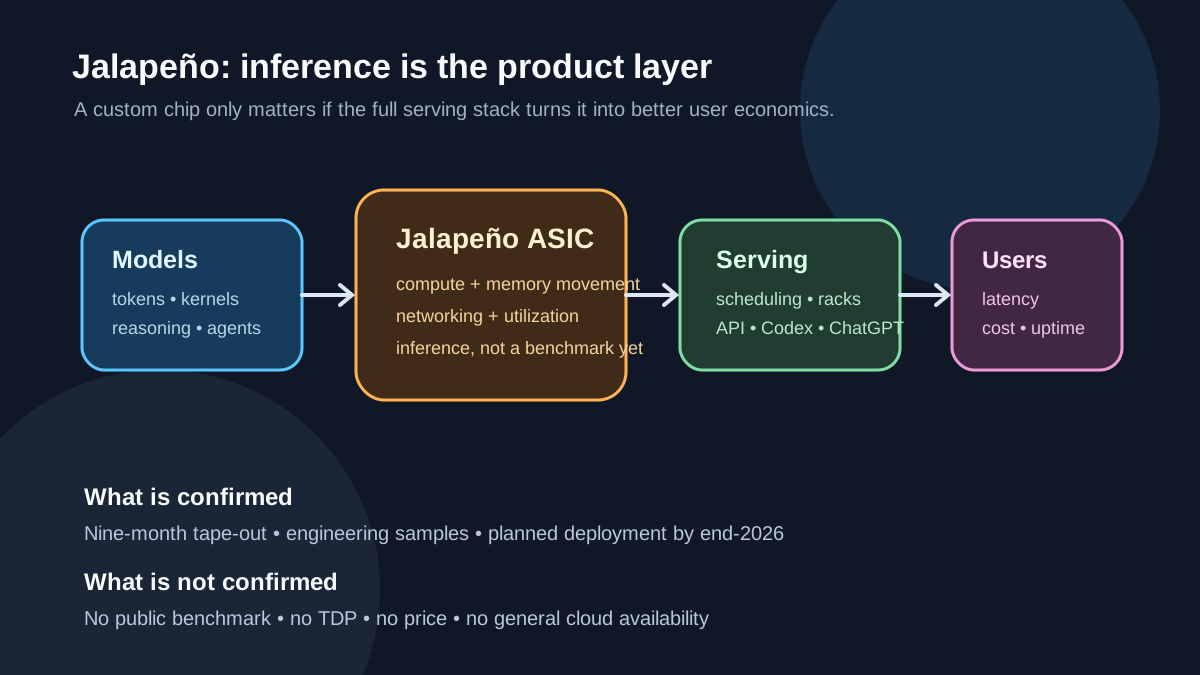
This is not a new consumer graphics card
On June 24, OpenAI and Broadcom announced Jalapeño, describing it as OpenAI’s first Intelligence Processor for large-language-model inference. The companies say the chip was designed around inference workloads, engineering samples are running at target frequency and power, and initial deployment is planned by the end of 2026.
The significance is not that consumers will buy an “OpenAI GPU.” It is that a model company is moving deeper into the infrastructure behind inference. Every ChatGPT response, long Codex task, and API token ultimately depends on data-center compute, memory, networking, and scheduling.
Separate facts, company claims, and inference
Confirmed facts
- OpenAI describes Jalapeño as the first generation of a multi-generation inference platform, with Broadcom and Celestica involved in implementation, boards, rack systems, and networking.
- Engineering samples are running machine-learning workloads, including GPT-5.3-Codex-Spark.
- The companies say the design reached tape-out in nine months and that initial deployment is targeted for the end of 2026.
- Broadcom describes gigawatt-scale data-center deployment beginning in 2026 with Microsoft and other partners.
Still an early company claim
OpenAI and Broadcom say early testing shows “substantially better” performance per watt than current state-of-the-art hardware. They have not published throughput, latency, power, memory capacity, per-token cost, or an independent reproduction. That supports “the infrastructure direction is important,” not “ChatGPT will immediately become faster and cheaper.”
Key unknowns
- Numerical benchmarks against NVIDIA, AMD, or other production accelerators.
- Process node, HBM generation and capacity, TDP, rack topology, and compiler details.
- Whether Jalapeño will become a general-purpose cloud accelerator for third parties.
- Which workloads the planned gigawatt-scale deployments will serve, and when they will change user-facing services.
Why build a separate inference chip?
Training and inference are different problems. Training emphasizes large-scale parallel computation. Inference handles real user requests every day, so it needs throughput, first-token latency, stability, and unit economics at the same time. Even a short answer can involve weight reads, KV-cache management, memory movement, network traffic, and multiple tool calls.
Jalapeño’s public rationale focuses on bottlenecks that do not appear on a model leaderboard: compute, memory movement, networking, and serving systems designed together. That does not guarantee success, but it explains why OpenAI may want more control than renting general-purpose GPUs.
| Layer | What Jalapeño aims to optimize | What users might eventually see |
|---|---|---|
| Models and kernels | Hardware fit for real operators | Lower latency for the same model |
| Memory and networking | Less data movement and waiting | More stable long-context or agent work |
| Scheduling and racks | Better device utilization | Fewer queues or failures at peak time |
| Supply | A multi-generation custom platform | Lower cost per token is possible |
The last column is a possibility, not an observed result. Only public service metrics or price changes can show whether the hardware advantage reaches the product layer.
What does a nine-month tape-out mean?
Nine months from design to tape-out is a strong engineering signal. OpenAI also says its models helped accelerate parts of chip design and optimization. A reasonable inference is that AI capability is being used not only on hardware, but also to help design the hardware that runs future AI systems.
There are two important boundaries. Tape-out is not mass production, and mass production is not stable delivery at scale. Yield, packaging, HBM supply, networking, and software still determine the final economics. “AI-assisted chip design” also does not mean the chip was autonomously designed by AI.
Custom silicon creates utilization risk as well. If model architectures, request patterns, or serving policies change quickly, the advantage of a specialized design can shrink. For developers, the useful signals are not the chip’s name but API latency, rate limits, pricing, context capacity, and regional availability.
Four downstream signals to watch
1. Latency, not launch-day peak numbers
Watch first-token latency, p95/p99 latency for long tasks, and stability during demand spikes. A single demonstration is not a production service profile.
2. Cost, not performance per watt alone
If inference costs fall, the effect could appear in API pricing, plan limits, free-tier quotas, or enterprise contracts. Until those changes happen, performance per watt should not be converted into user savings.
3. Reliability and regional coverage
An end-of-2026 deployment target does not mean global availability. Status data, rate limits, model routing, and failure recovery will be more useful than the word “gigawatt.”
4. Whether the platform opens beyond OpenAI
The companies say Jalapeño is designed for current and future LLMs across the industry. That is not a promise that it will be sold or rented openly. Third-party access will depend on software, supply, commercial terms, and OpenAI’s own capacity needs.
FAQ
Will Jalapeño replace NVIDIA GPUs?
There is no evidence for that conclusion. It is a specialized inference accelerator that may complement general-purpose GPUs. Until benchmarks, production scale, and workload data are public, nobody can say which platform will replace which.
Is it the same hardware project as Codex Micro?
No. Jalapeño is a data-center inference chip. Codex Micro is the developer input device previously teased by OpenAI. They are separate hardware tracks with different users, timelines, and technical questions.
When will ordinary users notice it?
Possibly through latency, reliability, model availability, or pricing, but the timing is unknown. The public commitment today is to engineering samples and an initial deployment direction by the end of 2026.
Conclusion: treat it as an infrastructure roadmap first
Jalapeño shows OpenAI moving from a model company toward a company integrating models, products, and infrastructure. That strategy could give it more control over inference cost and latency, while also creating manufacturing, supply-chain, and utilization risks.
For developers and enterprises, the safest conclusion is that the project deserves attention but is not yet a performance result that justifies changing budgets or architectures. Wait for benchmarks, production deployment, and service metrics. Then judge the chip by latency, price, reliability, and availability—the four ways infrastructure becomes a real product advantage.
Image and source note
The cover is an original Wesbase diagram and uses no OpenAI, Broadcom, or media photography. Sources include OpenAI’s announcement, Broadcom’s investor release and product-news index, with Tom’s Hardware used for technical context around the package and missing benchmarks. Claims about user benefits, supply, and utilization are labeled as inference or unknown rather than presented as independent measurements.