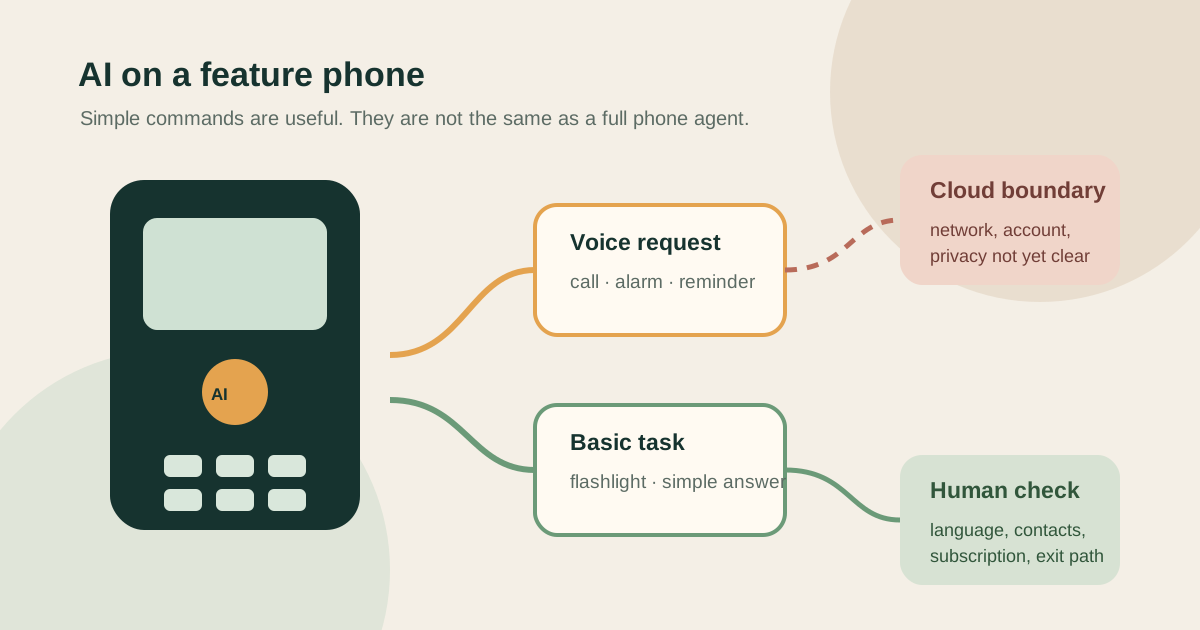
An AI button does not make a feature phone a full AI phone
The appeal of a feature phone is usually subtraction: fewer apps, fewer notifications, and fewer distractions. HMD’s new Nokia phones put an AI button into that minimalist package, creating a more interesting question than “does this phone have AI?”
The public evidence points to basic voice tasks: calls, alarms, the flashlight, reminders, and simple questions. The real buying test is whether AI makes a feature phone easier to use without quietly bringing back cloud accounts, subscriptions, and data costs.
What happened
In March 2026, HMD described a feature-phone roadmap that includes an AI assistant for everyday voice commands, video calling, lightweight chat, and a digital-wallet plan starting in India. HMD framed the work around older adults, under-connected users, and people who need simpler access to digital services.
In early July, media reports identified four Nokia-branded feature phones with a dedicated AI button: the Nokia 210 4G, Nokia 215 4G 2nd Edition, Nokia 235 4G 2nd Edition, and Nokia 200 4G. TechRadar listed examples such as placing calls, turning on the flashlight, setting alarms, creating reminders, making simple recipes, and producing short foreign-language phrases.
That may sound modest beside a flagship phone agent. For someone who does not want a touchscreen workflow or several layers of menus, modest may be the point.
Confirmed capability versus product promise
| Dimension | What is supported publicly | What is not confirmed |
|---|---|---|
| AI tasks | Calls, alarms, flashlight, reminders, simple answers | Long context, complex reasoning, multi-app automation |
| Interface | Dedicated button and voice access | Language, accent, hearing, and accessibility performance |
| Hardware | Feature-phone basics such as a headphone jack and microSD on reported models | Identical AI availability across every country and model |
| Service model | HMD is also building cloud and communication services | Complete offline operation, retention, and model provider |
| Cost | Media reports a trial period in some markets | Final device prices, subscription rules, and regional coverage |
The key boundary is that public material does not prove a local, account-free, offline AI. HMD is also building Xpress Chat and a digital wallet. The hardware may look retro; the service layer may not be.
Three readers, three decisions
If you want a simpler phone for an older adult: watch this space
One-button voice access may matter more than model intelligence. Saying “call my daughter” or “remind me in ten minutes” can be easier than navigating contacts and settings.
Still check volume, language, contact confirmation, and connectivity. A senior-friendly phone can work beautifully in a demo and fail at home because of accent recognition, weak signal, or account setup. AI can reduce menu depth; it cannot replace a clear emergency-contact plan.
If you want fewer social-media distractions: do not assume it is a pure dumbphone
A feature phone can remain a digital-minimalism tool, but AI, video calls, messaging, and cloud services create new entry points. It may remove short-video feeds without removing accounts, notifications, or network dependence.
Check whether the AI button can be disabled, whether the service pushes notifications, and whether Xpress Chat requires registration. Less screen temptation does not automatically mean minimal privacy.
If you want a complete AI phone: do not buy on this premise
The public capabilities look more like voice shortcuts than a general-purpose agent. There is no public evidence here of web research, multi-app form filling, long document handling, or complex offline model execution.
Calling it an AI assistant is a confirmed marketing and product description. Treating it as a full replacement for Gemini or ChatGPT is an inference without hands-on support.
Five checks before buying
- Connectivity: Does AI require mobile data or Wi-Fi, and what still works when coverage is poor?
- Language: Do not assume support for your language, dialect, or an older relative’s preferred language.
- Subscription: Treat 180 days as a trial, not permanent free access. Check renewal, cancellation, and account requirements.
- Privacy: Ask whether voice is uploaded, how long history is retained, how it can be deleted, and whether contacts or reminders enter the cloud.
- Exit path: Can the AI button be disabled, and what core functions remain if the service ends or is not renewed?
Facts, inference, and uncertainty
Confirmed: HMD has published a 2026 feature-phone AI direction. Media has verified four Nokia feature phones with an AI button and reported basic tasks and a trial period.
Reasonable inference: AI could give feature phones a new reason to exist, especially for older adults, accessibility, and digital minimalism. That does not mean every user needs it, or that one button solves the digital divide.
Still uncertain: exact prices, countries, language coverage, offline support, model provider, voice-data handling, subscription rules, and differences between models. Until the product reaches your market, do not treat a regional media price as a universal term.
FAQ
Are these Nokia feature phones full AI phones?
No. The confirmed scope is basic voice tasks and simple answers. It does not establish a multi-app agent, long context, or on-device model.
Does the AI button require the internet?
Complete offline support has not been confirmed. Because the phones include cloud services, check the exact model and regional documentation.
Will it cost money after 180 days?
TechRadar reports a 180-day trial and a regional annual fee in some markets. Confirm the final terms for your model and country.
Should I buy one now?
If you want fewer apps plus calls and reminders, wait for local pricing and hands-on reviews. If you need a full AI phone or strong offline privacy, do not buy for the button alone.
Image and source notes
The cover is an original Wesbase feature-phone AI boundary diagram. It uses no Nokia logo, product screenshot, or media artwork. HMD’s official page supports the feature-phone AI, video-call, digital-wallet, and older-adult direction; TechRadar supports the four models, AI button, basic tasks, and trial report. Cloud dependence, privacy, and purchase recommendations are analysis based on public gaps and reader scenarios, not a hands-on test of a specific model.