Bottom line
Cloudflare and OpenAI announced an AI search research pilot on July 8, 2026. The pilot asks whether network-level signals—freshness, traffic quality, and actual page changes—can help AI search systems discover and index relevant public-web content more accurately and on time.
That matters, but it should not be read as “Cloudflare sites will get ChatGPT traffic.” The evidence supports a narrower conclusion: AI search is testing richer signals about how the web changes. It does not yet support a claim that an individual site has gained rankings, citations, or referrals because of the pilot.
What happened?
Cloudflare says the pilot will combine signals observed across its network with OpenAI search capabilities and real user queries. The goal is to study whether search systems can find relevant, current content more efficiently.
This is not a normal model launch or a new ranking rule for publishers. It is closer to a test of whether a search system can learn that a page has genuinely changed, rather than repeatedly fetching millions of unchanged pages and hoping something is fresh.
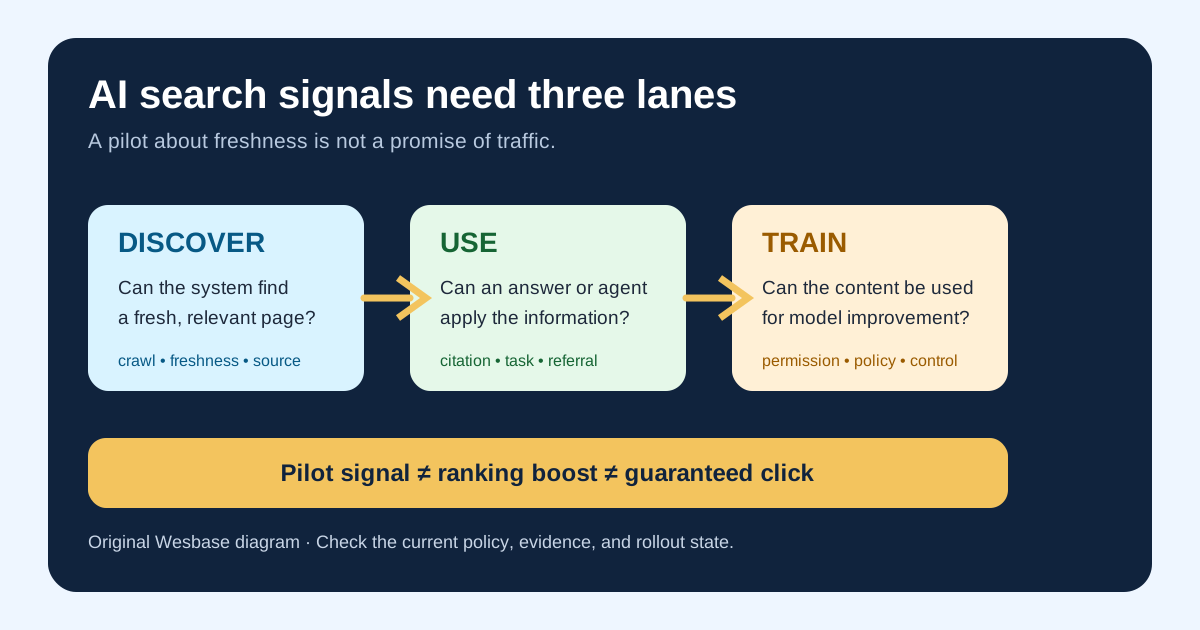
Keep three kinds of access separate
| Type | Main question | What a publisher can check | What it does not prove |
|---|---|---|---|
| Discovery / search | Can the system find a fresh, relevant page? | Crawlability, clear structure, stable sources | Discoverable does not mean cited |
| Use / agent | Can an answer or agent apply the information? | Facts, steps, limits, and permission boundaries | A fetch does not mean a useful click |
| Training | Can the content be used for model improvement? | Site policy and crawler controls | Allowing search does not require allowing training |
Cloudflare’s July 1 announcement separately discussed search, agent use, and training intent, along with future classifications, analytics, and commercial models. That is related to the July 8 pilot, but it is not the same announcement: the former includes product and policy plans, while the latter describes a research experiment.
Confirmed facts, inferences, and unknowns
Confirmed
- The July 8 announcement says Cloudflare and OpenAI are launching a research pilot.
- The pilot focuses on freshness, traffic quality, and actual page changes as network-level signals.
- Cloudflare says the parties will combine network signals, search capabilities, and real user queries to study discovery and indexing efficiency.
- Cloudflare’s July 1 release proposed separating search, agent, and training access, and described September 15, 2026 as a future point for tests and default-setting changes.
- Cloudflare’s AI changelog lists updates such as AI Search item-key filtering and Browser Run accessibility-tree support, but those features do not prove that a site will receive more AI citations.
Inference
If these signals become reliable, content maintenance may matter more than repeated crawling requests. Clear update dates, version notes, source links, and honest change logs could help systems judge whether a page is current.
That is still an inference. The public material does not identify pilot participants, publish a ranking formula, provide citation-lift data, or show that a particular setting can create more traffic.
Still unknown
- Whether the pilot changes ordering in ChatGPT or another answer system.
- Whether network-level signals become an open standard or remain part of partner testing.
- Whether analytics can cleanly distinguish impressions, citations, clicks, and training use.
- How September 15 defaults will vary by plan, region, and site state.
What should a publisher check now?
1. Make the page easy to understand
Important pages should have a stable URL, a precise title, an update date, an author or organization, source links, and a clear conclusion. Tutorials should also state the version, failure boundaries, and last verification date.
This is not about pleasing AI. It is about making the page legible to readers, search engines, and answer systems that need to judge what it says and when it remains true.
2. Do not treat every crawler as one switch
Review robots.txt, Cloudflare AI Crawl Control, or other CDN access rules. Confirm whether search discovery, agent use, and training are being mixed together. A site may choose to be discoverable in search without allowing training, or allow a citation without allowing unrestricted bulk extraction.
If you do not know the current state, document it before changing anything. A pilot announcement is not a reason to open every access path at once.
3. Separate discovery from value
If AI bot activity rises, ask three different questions: Was the page cited? Did the citation send a visitor? Did that visitor read, subscribe, buy, or complete a useful task? Crawl volume alone cannot answer any of them.
Cloudflare’s analytics and pay-per-use direction may eventually make those distinctions easier to observe, but they are part of an evolving product and ecosystem. They cannot replace evidence of citations, referrals, and real user value.
Act now, observe, or wait?
| Choice | Good fit | Next step |
|---|---|---|
| Act now | Sites with public guides, documentation, or original reporting | Add update dates, sources, canonicals, versions, and clear limits |
| Observe | Ad-, subscription-, or licensing-dependent publishers | Track search, agent, and training access separately; do not treat the pilot as a traffic promise |
| Wait before changing rules | Teams that have not confirmed current crawler policy | Inventory the current state before opening or blocking the whole site |
FAQ
Has the Cloudflare and OpenAI pilot already changed rankings?
The public announcement says the companies are studying how freshness, traffic quality, and page-change signals can improve AI search discovery and indexing. It does not promise rankings, citations, or referrals for an individual site.
What is the difference between search, agent use, and training?
Search generally discovers information for current answers, agent use may support a task, and training concerns model improvement. Their permissions and value should not be treated as one setting.
Should a small site allow every AI crawler?
No. Check the current robots, CDN, and AI crawler controls first, then decide separately about search discovery, agent access, and training use.
Can Cloudflare’s analytics guarantee AI citations?
No. Analytics may help observe bot activity and referrals, but citation, ranking, and useful traffic still depend on the answer system and content relevance.
Image and source notes
The cover is an original Wesbase SVG showing three lanes—discovery, use, and training—with no Cloudflare or OpenAI logo, official screenshot, or third-party image. Product facts come from Cloudflare’s July 8 research-pilot announcement, its July 1 Agentic Internet release, and the Cloudflare AI changelog. Claims that discoverability is not guaranteed traffic and that content maintenance may become more important are labeled as inference or uncertainty.