The easiest way to misread an AI policy announcement is to treat it as a law that already applies. On 15 July, the Australian Government announced an Office of AI and proposed a national standards path. That does not mean a complete AI Act is already in force.
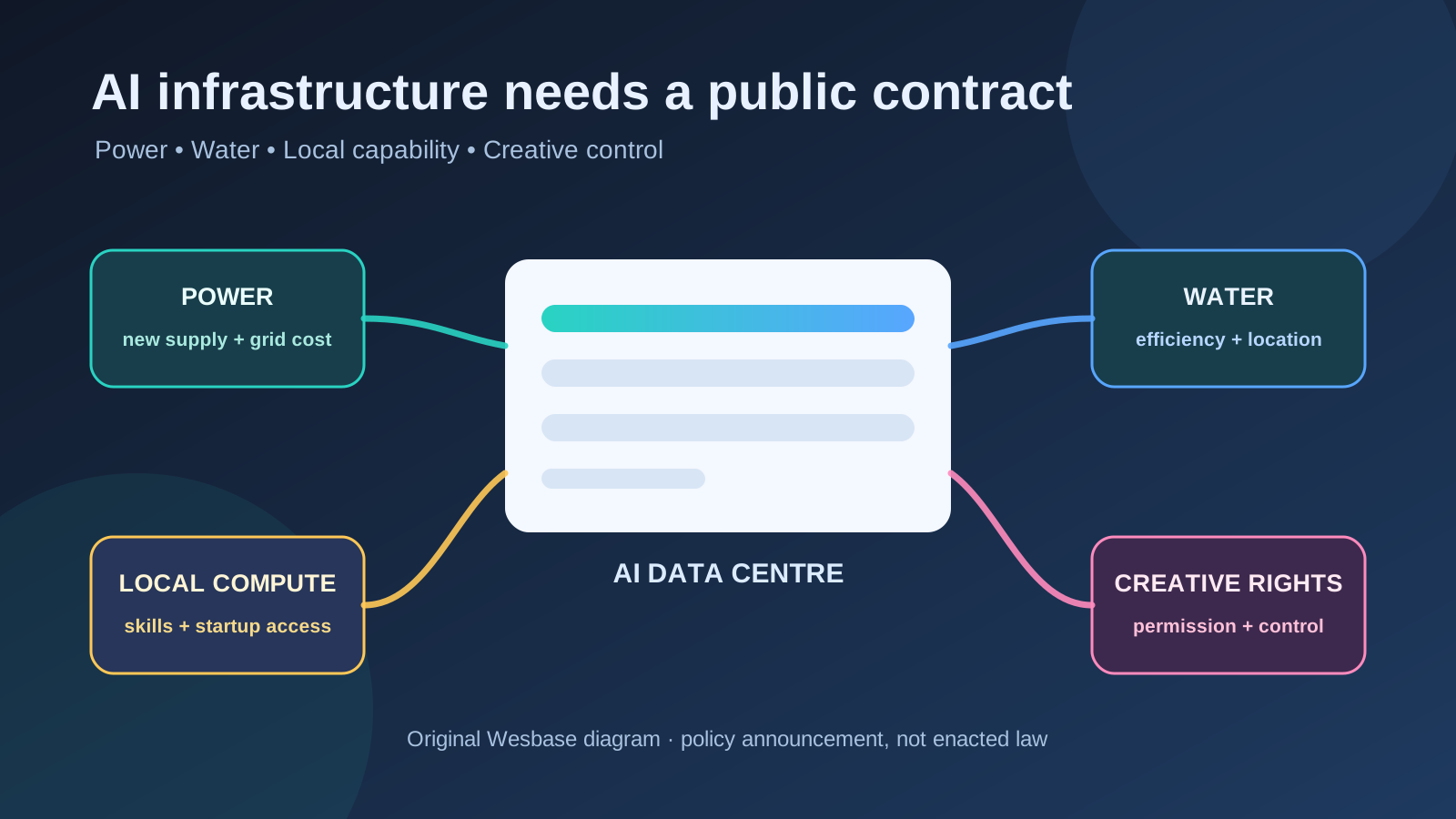
The important shift is more concrete: large AI infrastructure is being asked to explain where its power comes from, how it uses water, what local communities gain, and who controls creative work used to train AI.
What happened?
The government says the Office of AI will sit within the Department of the Prime Minister and Cabinet and accelerate the implementation of Australian Standards for AI. National Cabinet is expected to consider the approach in August, with legislation expected in early 2027.
The same announcement says large data centres should underwrite new power supply, pay their full grid-connection costs, reduce demand when the grid needs support and use water efficiently. It also says Australian writers, artists and journalists should retain ownership and control over their works used to train AI.
These are two different layers: the policy direction and expectations are confirmed; the covered entities, enforcement model, exemptions and effective dates still depend on future standards and legislation.
Why put data centres inside AI policy?
The AI race is moving from “which answer is better?” to “who can secure compute, energy, networking and data at scale?” Data centres are the physical base of AI services. Their costs include more than servers and accelerators: grid connections, land, water, planning approvals and local skills matter too.
That makes power and water part of the AI product story, not a side note. Australia’s March data-centre expectations already named national interest, energy transition, sustainable water use, skills and local innovation. The July announcement connects that framework to an Office of AI and future national standards.
This does not prove that every cloud service will become more expensive. A narrower inference is that new projects may need stronger evidence around site selection, energy procurement, community consultation and local benefit.
Four responsibility layers
| Policy question | Confirmed direction | What not to infer |
|---|---|---|
| Power | New data centres should support new supply, grid costs and demand flexibility | Every AI request will not suddenly receive a separate power surcharge |
| Water | Large facilities should use water efficiently and be located appropriately | A uniform national water cap has not been published |
| Local capability | Policy seeks skills, jobs, research and startup benefits | Every provider has not promised open public compute |
| Creative rights | The government says creators should retain ownership and control | A final licensing, compensation or opt-out mechanism is not known |
What changes for developers and businesses?
Most app users will not see an immediate interface change. The practical work is in deployment and procurement.
Developers can start with five checks:
- Region: Where are prompts, files, logs and backups processed?
- Cost model: Could regional compute, electricity or capacity constraints affect the contract?
- Rights provenance: Are training, fine-tuning, retrieval and generation materials authorised?
- Portability: Can the workload move if a model or API becomes unavailable in a region?
- Disclosure: Does the provider document data-centre location, policy changes and model-training practices?
Enterprise procurement should add energy, water, data residency, rights provenance and local service capability to its vendor questionnaire. These questions may not change the winner today, but they reduce the risk of treating model quality as the whole service.
Facts, inference and uncertainty
Confirmed facts: The Office of AI has been announced; Australian AI standards are a government proposal; National Cabinet consideration is expected in August; the government has described power, connection, demand-response and water expectations for large data centres; and it has publicly emphasised creator control.
Inference: Providers may need better records for energy contracts, site selection, community benefit and content permissions. Businesses may shift from “which model scores highest?” to “which service is auditable?” These outcomes are not confirmed by final law.
Still unknown: Whether the standards will cover existing facilities, inference-only sites, colocation providers and cross-border training; whether creator control means licensing, collective negotiation, opt-out or another mechanism; and how states and territories will implement the framework.
This is a policy explainer, not legal advice. Data-centre construction, content licensing and enterprise procurement should follow the final text and qualified professional advice.
What to watch next
The most useful next signals will be specific documents: the scope after the August National Cabinet discussion, definitions and exemptions in the 2027 bill, and how providers disclose power, water, copyright and local-compute responsibilities.
Consumers do not need to switch AI apps because of this announcement. Developers and businesses can, however, add provider transparency to their architecture and procurement checklists. AI infrastructure policy is moving from “should we build?” to “who carries the cost of scaling?”
Sources and image note
- Australian Government: AI in Australia’s interests: primary source for the Office of AI, proposed standards, data-centre responsibilities and creator control.
- Australian Department of Industry: New data centre expectations: background on the March expectations and five policy directions.
- The Guardian: Albanese’s AI plan: context for political and industry debate, not a substitute for the official text.
- The cover is an original Wesbase SVG diagram showing four responsibility layers. It is not an official government image and does not imply that the proposed standards are already law.